
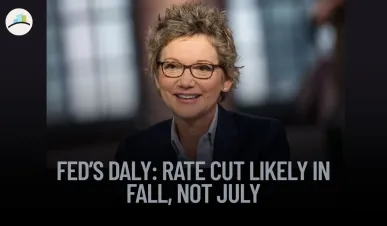
Fed Leadership Emphasizes Strategic Patience
In a firm yet measured tone, San Francisco Federal Reserve President Mary Daly clarified on June 20, 2025, that a rate cut in July is unlikely unless the labor market shows “meaningful and persistent” signs of deterioration. Daly’s message reinforces the idea that the Federal Reserve will continue to take a patient, data-driven approach to monetary easing.
While markets have speculated about the possibility of a near-term rate cut due to decelerating inflation, Daly emphasized that inflation alone will not trigger a pivot. Instead, the Fed will act only if the economy demonstrates clear signs that further restraint would pose a risk to employment and growth.
This stance places Daly firmly within the centrist camp of the Federal Open Market Committee (FOMC), signaling that the path forward is not about reacting to noise, but responding to sustained economic shifts.
More Articles:
Divergence within the Fed Reflects Internal Policy Debate
The FOMC’s latest “dot plot”—a summary of individual members’ interest rate projections—reveals a central bank deeply divided. Out of 19 officials, 12 expect one to three rate cuts in 2025, while seven foresee none. This reflects not only differing interpretations of current data but also diverging views on the risks of easing too early versus too late.
Daly’s stance adds further weight to the idea that the next few months will be about information gathering, not decisive action. With core PCE inflation still trending slightly above the 2% target, the Fed appears unwilling to loosen policy prematurely—especially after being criticized for misjudging inflation’s trajectory earlier in the decade.
Inflation and Tariff Risks Remain Wildcards
While inflation metrics have moderated, they are not comfortably within target. Daly acknowledged that while inflation is "clearly improving," it is not yet at a point where the Fed can afford to ease without risking a rebound. She also downplayed the immediate inflationary impact of recently discussed tariffs but warned that renewed trade tensions could still pose risks to price stability.
The Fed’s careful attention to geopolitical developments suggests that its monetary policy will remain cautious until more clarity emerges. As Daly noted, premature easing could compromise credibility, while excessive restraint could tighten labor conditions too far.
This balancing act underscores the complexity of monetary decision-making in 2025—a year defined not just by inflation but also by overlapping macro uncertainties, including energy shocks, wage rigidity, and global policy divergence.
Financial Markets Adjust to New Timeline
Market participants have taken Daly’s comments seriously. Futures markets, which had priced in the possibility of a July rate cut, have now shifted expectations toward the fall. As of mid-June, traders see a high probability of two 25-basis-point cuts beginning in October, assuming inflation continues its cooling trajectory and labor markets show further softening.
This shift in market sentiment reflects growing acceptance that the Fed’s easing cycle—if it comes—will be gradual, cautious, and heavily contingent on incoming data.
Investors are increasingly calibrating their portfolios with this in mind, favoring short-duration bonds, defensive equities, and inflation-protected securities. Analysts are also beginning to reevaluate risk models that had previously assumed a more aggressive easing timeline.
Key Strategic Insights and Non-Googleable Value Adds
1. Employment Risk is the New Trigger:
Unlike earlier periods when inflation overshoots prompted policy shifts, Daly's language suggests that employment metrics—particularly persistent weakness—will now act as the primary catalyst for rate action.
2. Delaying to Fall Reflects Tactical Flexibility:
Waiting until September or October allows the Fed to review additional quarters of inflation and jobs data. This provides better visibility on whether recent improvements are sustainable or merely statistical noise.
3. Slower Cadence in Rate Cuts Expected:
Even if the Fed initiates cuts in the fall, the path is likely to be slow—possibly just two 25-bps reductions through year-end. This tempered pace reflects the Fed’s desire to avoid stoking inflation expectations while also maintaining credibility.
4. Geopolitical Risks Inform the Cautious Tone:
From potential tariffs to energy price volatility, the Fed is aware of external forces that could disrupt disinflation. The fall timeframe provides a strategic window to monitor these without being forced into reactionary policy shifts.
5. Political Season Could Add Pressure:
With 2025 being a politically sensitive year, the Fed may want to avoid taking any actions that could be interpreted as political interference. Delaying action until later reduces this exposure.
🚨 Fed’s Mary Daly just signaled: no July rate cut likely. She’s eyeing fall for a possible policy shift.
— TM Research (@TMResearch2025) June 20, 2025
✅ Inflation cooling (esp. housing/services)
✅ Hiring conditions improving
✅ AI = productivity booster, not job killer (yet)
👉 She warns: more labor softening could flip… pic.twitter.com/vSMmsbqQPP
Procapitas Final Take
Mary Daly’s statements mark a clear signal that the Federal Reserve is not rushing into the next policy phase. Rather, it is observing, modeling, and preparing for an eventual cut—if conditions warrant. Investors should not expect dramatic easing in the near term, but rather a meticulously crafted sequence starting in the fall.
This positioning offers both stability and flexibility—traits that could prove essential as global economic dynamics remain in flux.
For investors, this means focusing less on the timing of the next move and more on the trend of data. Portfolios that are adaptive to gradual changes in rates, rather than binary shifts, will likely outperform.
Disclaimer:
This article is intended for informational purposes only and does not constitute investment advice. Procapitas does not provide personalized financial recommendations. Always consult a licensed financial advisor before making investment decisions. Information is based on publicly available sources as of June 2025 and Procapitas’ independent research and analysis.



