
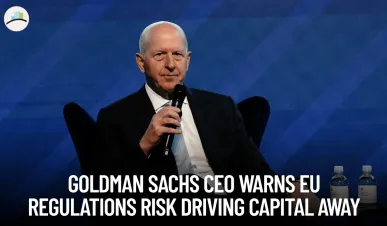
When David Solomon, the high-powered CEO of Goldman Sachs, takes to the pages of a French newspaper to air his frustrations, it’s worth paying attention. In a candid opinion piece in Les Echos, Solomon warned European regulators that their rules are starting to strangle more than just paperwork—they're choking off capital, innovation, and growth.
To outsiders, this might sound like Wall Street whining. But underneath the usual banker bravado is a deeper, more unsettling truth: Europe might be engineering its own financial decline.
Why Is This Happening Now?
Solomon’s comments didn’t just drop out of the sky. With the EU fresh off a new round of elections and the next wave of Brussels leadership gearing up to set the regulatory agenda, this is a strategic moment to influence the conversation.
He’s not the only one ringing alarm bells. Across trading desks, boardrooms, and startup accelerators, the message is echoing louder: Europe’s rules may be too heavy for today’s markets to carry.
Solomon specifically called out what he described as "overbearing" and "prescriptive" regulations—an approach that might have been built with good intentions, but now feels increasingly like a straightjacket. Meanwhile, markets in the U.S., Singapore, and the Middle East are offering lighter-touch regimes—and investors are following.
📉 Goldman Sachs CEO David Solomon calls for Europe to rethink its "overbearing" regulations, arguing they hinder investment and growth. Time for change! #Finance #EU #Investment #Regulation 📈https://t.co/2SnpBYowXW
— Global Banking & Finance Review (@GBAFReview) June 24, 2025
The Part No One Wants to Talk About
Here’s what rarely makes the headlines: Europe’s fragmentation. The EU talks about being a single market, but try setting up a financial product across 27 jurisdictions with 27 different interpretations of the same regulation—it’s a regulatory Rubik’s Cube.
Another issue hiding in plain sight? Sustainability rules that, while admirable in ambition, are becoming a logistical nightmare. ESG disclosures are turning into a paperwork marathon, especially for global firms trying to meet ever-changing criteria in multiple regions.
It’s not that companies want to ignore climate or ethics—it’s that they need a runway long enough to get off the ground.
Europe’s Economic Edge Is Eroding
Solomon’s comments were blunt, but they tap into a growing anxiety among financial professionals: is Europe losing its edge?
The data isn’t comforting. Europe’s share of global financial services exports has dropped by about 10 percentage points over the last 15 years. Not a single one of the top 10 IPOs in 2024 happened in the EU.
Capital, like water, flows to where there’s least resistance. And right now, that’s not Brussels.
If left unchecked, this slow erosion could turn into a brain drain—of capital, of companies, and of the talent building the future of finance. The continent that once gave us the Eurozone and MiFID may soon be better known for exporting its financial ambitions elsewhere.
What's at Stake—And What Could Go Right
Let’s not sugarcoat it: Europe is at a crossroads. Continue layering on regulation without coordination, and it risks becoming a well-intentioned bureaucratic museum, full of values but short on velocity.
But here’s the upside: if Europe can streamline its rules, embrace innovation without abandoning its principles, and finally harmonize across borders, it could build something unique. A financial system that’s both ethical and agile—something neither Wall Street nor Shanghai has fully nailed.
That’s the opportunity. But it won’t last forever.
History’s Warning Shot
We’ve seen this movie before. After the 2008 crisis, the U.S. acted swiftly with Dodd-Frank. Europe, by contrast, went the long route—complicated directives, slow rollouts, and overlapping authorities.
Fast forward, and U.S. markets recovered faster, attracted more capital, and captured fintech momentum. The next chapter could follow the same script if Europe doesn’t change its regulatory tempo.
Solomon may be sounding self-serving, sure. But his warning also feels eerily familiar—and timely.
More Article:
Trump Announces Ceasefire Between Iran and Israel: What Does This Mean?
The Bottom Line
This isn’t just about Goldman Sachs or bankers bristling at paperwork. It’s about Europe’s future role in the global economy. Regulation is vital—no one wants a return to Wild West finance—but rules need to enable, not disable, smart growth.
Europe has a chance to be the global leader in responsible finance. But it must avoid becoming the world’s most expensive place to do the right thing.



