
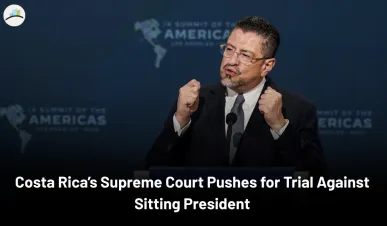
The Court Just Took a Big Step — Now It’s Up to the Assembly
So, here’s what happened. Costa Rica’s top court—kind of like their Supreme Court—just made a rare and bold move. They asked the country’s lawmakers to strip President Rodrigo Chaves of his legal protection, which means he could face trial while still in office. The court voted 15–7 in favor of this. Why? Because prosecutors say there was something shady about a $32,000 consulting deal tied to Chaves’ 2022 campaign. They’re claiming it wasn’t just a mistake—it might’ve been illegal.
Now, it’s not every day you hear of a president in a stable democracy like Costa Rica being asked to go to trial while still running the country. That’s what makes this so unusual and honestly, kind of tense. If the Assembly says yes, things could shift very quickly.
🇺🇸 Stuck in the Senate: Trump’s Mega-Bill Falters
— Beyond Wars (@BeyondWars) July 1, 2025
After an all-night session, Republicans still can’t secure votes for Trump’s $3.3T tax & immigration bill — risking default, Medicaid cuts, and GOP infighting.#Trump #Senate @washingtonpost
READ⬇️https://t.co/qRCNAFGbRH pic.twitter.com/ptOMmJeX7I
Why This Isn't Just Another Political Drama
At first glance, this may seem like just another corruption case in Latin America—but it’s bigger than that. This is about whether Costa Rica’s system still works the way it’s supposed to. The president has clashed with judges before and called out oversight agencies. Some people love him for being direct. Others say he's crossing the line and trying to weaken the country’s democratic checks.
If lawmakers reject the court’s request, it could send a message that presidents can’t be held accountable. But if they accept it and the trial begins, it’ll be the first time a sitting president in Costa Rica is actually brought to court. Either way, it puts a lot of pressure on the country’s institutions.
What People Aren’t Really Talking About Yet
Here’s what most headlines won’t say: this whole situation could shake up Costa Rica’s image abroad. Investors and global companies usually see Costa Rica as a pretty safe bet in Central America. It has stable politics, educated workers, and no military interference. But now? There’s a risk that ongoing political tension could slow down new projects, make international deals harder, or even scare off investors who don’t like unpredictability.
Plus, if this turns into a long fight between the president and the courts or parliament, regular government work might slow down. That includes everything from infrastructure deals to climate programs to budget planning.
Could This Be a Good Thing in Disguise?
It might sound strange, but this could also be a moment of strength for Costa Rica. Most countries in the region don’t allow courts to challenge a sitting president like this—so the fact that it’s happening means the system is trying to stand its ground. If everything is handled fairly, openly, and with respect for the law, Costa Rica could actually come out of this looking stronger than before.
This could be a chance for the country to prove it can balance power without chaos. It’s also an opportunity to remind people that rule of law isn’t just for ordinary citizens—it applies to everyone, even presidents.
More Articles:
What’s Coming Up Next
-
The Assembly (basically their parliament) has to vote on whether to remove the president’s immunity. They need a two-thirds majority to do it.
-
If they vote yes, President Chaves could be formally charged and might have to appear in court while still in office.
-
If they say no, it could trigger a standoff between the judiciary and the political leadership—something that hasn’t happened at this level before in Costa Rica.
Final Thought
This is more than just a legal or political headline. It’s one of those moments that shows what kind of country Costa Rica wants to be. Can a democracy truly hold its leaders accountable? Can it do that without falling apart? Those are the real questions here. And whatever happens next, it’s going to shape the future of Costa Rica for years to come.



