
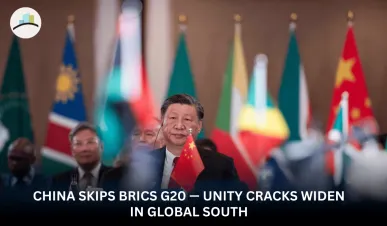
BRICS Fractures Deepen as China Skips Durban G20 — A Global South Power Play at Risk?
The decision by Chinese representative Bessent to skip the upcoming G20 ministerial meetings in Durban has sent ripples through the corridors of global diplomacy. While officially unspoken, the move underscores growing tensions within the BRICS alliance and raises fresh doubts about the bloc’s unity at a time when it was expected to take a more assertive stance against Western-dominated institutions.
The BRICS’ expansion in 2024, with new members like Egypt, Iran, and Ethiopia, was seen as a historic pivot toward multipolarity. But barely a year later, internal rivalries, unclear strategic direction, and China's quiet disengagement threaten to unravel the narrative.
Why This Happened: China’s Strategic Silence
-
Internal BRICS divisions becoming public
Friction between founding BRICS members—especially India, Brazil, and China—is increasingly evident. Competing regional ambitions and economic misalignments have undermined the bloc’s coherence. -
China refocuses inward amid economic pressures
With its economy slowing, Beijing is shifting attention toward domestic stabilization. Skipping Durban signals that global south diplomacy is no longer a top priority—at least not through BRICS channels.
What’s Not Being Discussed Enough: The Credibility Crisis Within BRICS
-
Leadership vacuum post-expansion
The inclusion of six new nations has diluted strategic clarity. There is no clear leader or institutional structure to manage diverging national interests. China’s absence only deepens this leadership void. -
BRICS+ at risk of becoming a symbolic club
Without tangible policy coordination—especially on finance, energy, and trade—the expanded BRICS risks turning into a geopolitical talking shop rather than a counterweight to the G7.
MORE ARTICLES
Geopolitical and Economic Implications
-
Global South disappointment could grow
Many emerging economies looked to BRICS as an alternative to IMF and World Bank dominance. With China stepping back and coordination lagging, that hope could wane, weakening the bloc's moral authority. -
De-dollarization efforts could stall
One of BRICS’ core agendas—reducing reliance on the U.S. dollar in trade—requires strong political backing. China’s absence from key summits could slow the creation of common settlement mechanisms or new currency frameworks.
Historical Parallel: The Non-Aligned Movement’s Fade
This isn’t the first time a South-led coalition stumbled. The Non-Aligned Movement of the Cold War era also struggled with divergent national priorities, ideological splits, and leadership disputes—ultimately becoming irrelevant in realpolitik. BRICS+ now teeters on a similar precipice.
Hidden Opportunities: Time for Structural Reform
-
Push for formal governance mechanisms
If BRICS is to evolve, it needs permanent structures, transparent decision-making, and financial integration tools (e.g., a BRICS Development Bank 2.0 with broader mandate). -
India and Brazil could assert leadership
With China stepping back, middle powers like India or Brazil could seize the moment to drive a new strategic agenda—potentially more democratic and multipolar in vision.
The Bottom Line: Multipolarity Needs More Than Rhetoric
Durban was meant to showcase BRICS unity. Instead, China’s no-show reveals the cracks beneath the surface. Without clear leadership, internal coherence, and deliverables, BRICS risks sliding into irrelevance—leaving the vision of a “Global South Century” hanging in limbo.



