
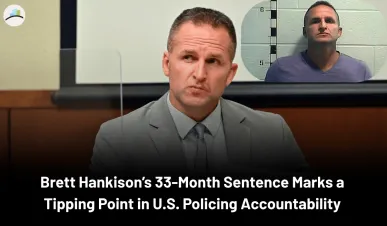
When former police detective Brett Hankison was sentenced this week to 33 months in federal prison for civil rights violations during the 2020 raid that led to Breonna Taylor’s death, many hailed it as a long-awaited reckoning. But beneath the surface of public reaction lies a deeper, more complex story—one that reflects growing fractures in federal accountability, political influence on law enforcement oversight, and a justice system wrestling with its own credibility.
U.S. JUDGE SENTENCES FORMER LOUISVILLE POLICE OFFICER TO 33 MONTHS IN PRISON FOR VIOLATING BREONNA TAYLOR'S CIVIL RIGHTS pic.twitter.com/RMHnvKp4MH
— Popitics (@Popitics1) July 22, 2025
Why This Matters Now
At a glance, this sentence may seem like a victory for reform. But the truth is far more nuanced. Hankison’s conviction was the only criminal accountability achieved in Taylor’s killing, and yet he wasn’t convicted for killing her. He was convicted for the reckless, blind firing that endangered neighbors—ironically, not for Taylor’s actual death. And this raises a piercing question: Is the justice system still unable—or unwilling—to hold law enforcement accountable for the direct consequences of fatal raids?
Even more telling is the U.S. Justice Department’s recommendation of a one-day sentence—a move almost unprecedented in federal civil rights cases. It reflects a broader, more alarming shift: a reorientation of federal priorities under a post-Biden administration that appears less committed to police oversight.
The Political Undercurrent: More Than Just a Sentence
What the mainstream conversation is missing is the significance of DOJ's role reversal. Under the previous administration, the Justice Department took a tough stance on civil rights violations and launched pattern-or-practice investigations into systemic police misconduct. Under the new leadership, the tone has changed markedly.
By advocating leniency for Hankison, DOJ has essentially sent a coded message to law enforcement nationwide: "Even when you are found guilty, the system may still protect you." This posture, some legal analysts argue, could chill ongoing investigations or discourage whistleblowing within departments.
The political implications are far-reaching. If federal oversight mechanisms are weakened, state prosecutors—many of whom are elected—become the last line of defense. This returns the burden to local political dynamics, which can be heavily swayed by police unions and public sentiment.
What's Not Being Discussed: The Legitimacy Crisis
The lesser-discussed consequence of Hankison’s case isn’t just about justice—it’s about legitimacy.
In the eyes of many citizens, particularly marginalized communities, the U.S. legal system operates with a double standard. The DOJ’s handling of this case risks deepening public mistrust, particularly after high-profile reversals of consent decrees in cities like Louisville and Minneapolis earlier this year.
Legitimacy is not just a moral issue—it has economic implications too. Cities facing civil unrest over perceived injustice often see insurance claims spike, commercial real estate values fall, and tourism stall. According to a 2021 study by the National Bureau of Economic Research, cities that experienced protests after police shootings witnessed a 10–15% drop in local consumer activity over six months.
More Articles:
The Economic and Legal Fallout
Louisville, still grappling with the aftershocks of Taylor’s killing, has implemented partial reforms, but those changes now hang in the balance. The city's fragile progress—like community-based oversight boards—may be undermined if the federal government continues to backpedal on meaningful intervention.
Meanwhile, police liability insurance costs are quietly increasing nationwide. With every high-profile case, insurers reassess their risk exposure. Municipalities—already under fiscal stress—may soon find themselves footing higher premiums for officers with prior complaints or settlements.
The sentencing also comes as private sector risk assessments begin factoring civil unrest probability into urban investment decisions. For institutional investors and real estate funds, the specter of unresolved systemic justice issues is becoming a red flag for long-term investment, especially in high-density metropolitan areas.
Hidden Risk: Precedent Weakening
Perhaps the most under-reported angle is what this sentence might do to future federal civil rights enforcement. The Hankison case, though resulting in prison time, sets a precedent in tone—one that could erode the legal standard for "willful disregard" under color of law.
Historically, civil rights convictions under Section 242 of the U.S. Code were rare and hard-won. A weak sentence here, coupled with DOJ hesitation, may deter prosecutors from pursuing borderline cases, fearing the effort will not result in meaningful consequences.
What This Signals for 2026 and Beyond
As the country inches closer to the 2026 election cycle, policing will again become a flashpoint. Candidates on both sides will likely weaponize the Hankison verdict—progressives pointing to the inadequacy of the DOJ's actions, conservatives citing it as proof that police are under siege.
But the real issue may be apathy. Without systemic follow-through, this sentence could become just another symbolic gesture—acknowledged, but not transformative.
Final Thought
Brett Hankison’s 33-month sentence is not the end of a legal story—it’s the beginning of a political and societal reckoning. The case illustrates how justice, in the American context, remains not only elusive but increasingly shaped by politics, not principle. The hidden risks now lie in how institutions respond—or fail to—when precedent, policy, and public trust collide.
If history is a guide, the failure to uphold justice uniformly will not just cost public trust—it could reshape the American legal landscape for decades.



