
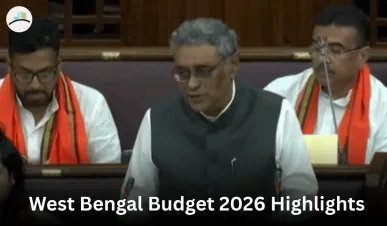
West Bengal Budget 2026 has become one of the most watched state budgets of the year, not just because of its big-ticket announcements, but because it marks the first full budget of Bengal’s new BJP government. Finance Minister Swapan Dasgupta used the budget to send a clear political and economic message: higher DA for government employees, one lakh government jobs, a ₹36,000 crore women-focused Annapurna Yojana, and a major push for airports, education, health and infrastructure.
West Bengal Budget 2026: Why This Budget Matters
The 2026 West Bengal Budget is politically important because it is the first full budget presented by the BJP government in the state after its Assembly election victory.
Finance Minister Swapan Dasgupta presented the budget under the government led by Chief Minister Suvendu Adhikari. According to The Times of India, the budget came nearly two months after BJP’s victory ended 15 years of Trinamool Congress rule in West Bengal.
That is why this budget is not only a financial document. It is also the new government’s first major attempt to show how it wants to govern Bengal differently.
The focus areas are clear: welfare, jobs, industry, government employees, women, infrastructure and fiscal discipline.
DA Hike: Big Relief For Government Employees
One of the biggest announcements in the West Bengal Budget 2026 is the Dearness Allowance hike for state government employees and pensioners.
The government announced a 20 percentage point increase in DA, taking the total DA rate to 38%. The hike will come into effect from October 1, 2026.
This announcement is important because DA had been a long-running issue in Bengal. State government employees had repeatedly demanded parity with central government employees.
For many employees, this is likely to be seen as one of the most direct relief measures in the budget.
1 Lakh Government Jobs Announced
The budget also announced a major recruitment push.
Swapan Dasgupta said the government would fill 1 lakh government vacancies in phases. According to The Times of India, this includes 20,000 police posts and 50,000 teaching and non-teaching posts in schools. The government also said 33% of these jobs would be reserved for women, while 10% reservation would be provided for Agniveers wherever applicable.
This is one of the strongest youth-focused announcements in the budget.
For a state where unemployment and government recruitment delays have often become political issues, the promise of one lakh jobs is likely to attract major attention.
₹36,000 Crore For Annapurna Yojana
The biggest welfare allocation in the West Bengal Budget 2026 is for Annapurna Yojana.
The government has set aside ₹36,000 crore for the women-focused scheme. The Economic Times reported that Dasgupta said the government would continue existing social welfare schemes while making reforms where required.
The Annapurna Yojana is being positioned as a direct financial assistance scheme for women. The Times of India reported that budget estimates suggest the allocation could cover around one crore women beneficiaries receiving ₹3,000 per month.
This makes the scheme one of the biggest political and welfare announcements of the budget.
Is Annapurna Yojana Replacing Lakshmir Bhandar?
The Annapurna Yojana is being seen as the BJP government’s reworked version of Bengal’s earlier women-focused welfare system.
The Times of India reported that the BJP government renamed the previous Lakshmir Bhandar scheme as Annapurna Yojana after coming to power. The report also said revised eligibility norms and stricter verification measures have been introduced to remove duplication and ensure benefits reach eligible beneficiaries.
This part may become politically sensitive.
Supporters may call it a cleaner and better-targeted scheme. Critics may question whether some beneficiaries are being excluded. That debate could continue beyond budget day.
Big Infrastructure Push In Bengal Budget 2026
The West Bengal Budget 2026 also places strong emphasis on infrastructure.
The government announced plans for a second airport for the Kolkata region, with 1,000 acres to be identified in Kalyani for a greenfield airport. New airports are also proposed in Purulia, Balurghat and Malda under the Centre’s UDAAN scheme, while Cooch Behar Airport is set to be expanded.
This is a major announcement for connectivity.
If implemented well, it could help reduce pressure on Kolkata airport and support regional development in north and south Bengal.
₹900 Crore For Chingrighata-New Town Corridor
Urban connectivity also received attention in the budget.
The government allocated ₹900 crore for the Chingrighata-New Town elevated corridor. It also announced ₹1,200 crore for a new bridge over the Bhagirathi River.
These projects are important because Kolkata and its surrounding regions face heavy traffic pressure. Better road and bridge connectivity could become a key part of the government’s urban development story.
Education And Health: IIT, IIM and AIIMS Push
The budget also made major announcements for education and health infrastructure.
According to The Times of India, Swapan Dasgupta announced plans for IIT and IIM campuses in north Bengal. The budget also proposed AIIMS and a cancer hospital in north Bengal, along with new medical colleges in Alipurduar and Paschim Bardhaman. MBBS seats are also expected to increase by 650 across 13 medical colleges in the state.
This is important because north Bengal has often complained of being ignored in major development planning.
By focusing on institutions like IIT, IIM and AIIMS, the government is trying to send a message that education and healthcare expansion will not be limited to Kolkata.
Salary Hikes For Workers And Teachers
The budget also includes salary and wage hikes for several categories of workers.
Anganwadi and ASHA workers will get a monthly increase of ₹5,000. Civic volunteers, Green Police personnel, NVF workers, Prani Bandhu and Prani Mitra workers will receive an additional ₹2,000 per month from August. Para-teachers in state-run schools will also get a ₹5,000 monthly salary increase.
Mid-day meal cooks will get a ₹1,000 monthly increase, while the mid-day meal allocation for each student will be raised to ₹10.
These announcements target groups that have strong local-level presence across Bengal.
MLA Fund Increased To ₹1 Crore
The West Bengal government also announced that MLA Local Area Development Fund allocation would be increased from ₹70 lakh to ₹1 crore annually.
This gives MLAs more funds for local development work in their constituencies.
Politically, this can help the new government show faster ground-level development, especially in areas where voters expect visible changes after the election.
Bengal Budget 2026 Focuses On Debt And Fiscal Discipline
The budget also acknowledged Bengal’s financial pressure.
The Times of India reported that Swapan Dasgupta said the government had inherited a debt burden of ₹8.15 lakh crore. He said the government would focus on restoring fiscal discipline while continuing welfare programmes.
This is one of the most important parts of the budget because the government is trying to balance two things at once.
On one side, it has announced major welfare and salary spending. On the other side, it has promised fiscal discipline and better governance.
Whether both can be achieved together will be the real test.
MORE ARTICLES:
Industry, AI And Investment Push
The budget also tries to present Bengal as an investment-ready state.
The government announced an Artificial Intelligence Mission to promote emerging technologies and innovation. A semiconductor unit has been proposed in Durgapur, while an IT park is planned in Siliguri. The Urban Land Ceiling and Regulation Act will also be reexamined to unlock investment potential in the state.
These announcements show that the government wants to move beyond welfare and talk about industry, technology and jobs.
But the real impact will depend on execution, investment approvals and how quickly projects move from announcement to ground work.
Why ABP Ananda Live Searches Are Rising
Many people are searching “ABP Ananda live” and “ABP Ananda West Bengal Budget 2026” because Bengali viewers want real-time updates in their own language.
ABP Ananda reported before the budget that Swapan Dasgupta said the budget would carry “a lot of new message” while also keeping some continuity. The report also said the budget was presented under Chief Minister Suvendu Adhikari’s first full state budget exercise.
For Bengali audiences, live TV and live YouTube updates are often the fastest way to follow budget announcements, especially around DA, jobs, welfare schemes and local infrastructure.
Political Message Of The Budget
The political message of the West Bengal Budget 2026 is very clear.
The BJP government is trying to show that it can continue welfare while also changing the direction of governance. It is targeting women through Annapurna Yojana, employees through DA, youth through job announcements, and business groups through infrastructure and investment proposals.
It is also trying to claim a “new Bengal” narrative after years of TMC rule.
But the opposition is likely to question implementation, funding, beneficiary cuts and whether the announcements can be delivered on time.
Final Takeaway
West Bengal Budget 2026 is a high-impact budget with a clear mix of welfare, jobs, infrastructure and political messaging.
The biggest announcements include a DA hike to 38%, 1 lakh government jobs, ₹36,000 crore for Annapurna Yojana, new airports, IIT-IIM-AIIMS plans in north Bengal, salary hikes for workers and major infrastructure projects.
For the BJP government, this budget is the first big test of its governance promise in Bengal. For citizens, the key question is simple: how quickly will these announcements turn into real benefits?



