
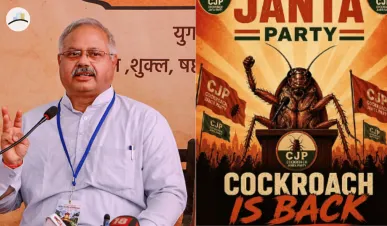
RSS Calls Cockroach Janta Party Debate a Normal Part of Democracy as Gen Z Movement Crosses 20 Million Instagram Followers
RSS Prachar Pramukh Sunil Ambekar urged calm over the viral satirical movement, saying differing opinions are a natural feature of healthy democratic discourse and should not be treated as a shock.
The Rashtriya Swayamsevak Sangh (RSS) has publicly weighed in on the rapidly growing Cockroach Janta Party (CJP) controversy, with senior RSS leader and Prachar Pramukh Sunil Ambekar stating that the movement's emergence reflects the ordinary functioning of democratic societies rather than a threat to political order.
Speaking on the controversy, Ambekar said, "Differing opinions should not be taken as a shock. They are part of the normal democratic process." His remarks, reported by The Sunday Guardian on May 30, 2026, come as the CJP's online following has grown to a scale that has drawn attention from political parties and civil society organisations alike.
Other Stories-
-If Simpsons Restaurant Can’t Survive: What Does It Say About the UK Restaurant Industry?
-Infosys Pay Check: Salil Parekh ₹82.6 Crore Compensation 742x Median Employee Pay Explained
-Backrooms Movie Explained: Ending, Post-Credit Scene, Cast & Reviews
What is the Cockroach Janta Party?
The Cockroach Janta Party is an Indian satirical political movement founded on May 16, 2026, by Abhijeet Dipke, a political communications strategist who formerly worked with the Aam Aadmi Party. It emerged in response to remarks made by the incumbent Chief Justice of India, Surya Kant, on May 15, 2026, in which he compared unemployed youth to "cockroaches" and "parasites of society" during a Supreme Court hearing on a contempt petition related to senior advocate designations and fraudulent professional credentials.
Justice Surya Kant later clarified that his remarks were directed at people entering professions using fake and bogus degrees, and not at unemployed youth broadly. However, the backlash had already gathered momentum online.
Dipke, a 30-year-old recent graduate in public relations from Boston University in the United States, built the party's online presence within 24 hours of first posting about it, leveraging artificial intelligence tools including Claude and ChatGPT to design its look and manifesto.
Scale of the movement
Within days of its founding, the movement garnered over 350,000 sign-ups and over 20 million followers on Instagram eclipsing the social media following of both the ruling Bharatiya Janata Party and the Indian National Congress. The movement's X account had crossed one million followers before it was taken down. Dipke subsequently launched another account, "Cockroaches Are Back," which attracted under three lakh followers.
According to Dipke, over 94 percent of the platform's followers are from India, and most belong to the 17 to 28 age group.
Controversy and crackdown allegations
The party's X account was reportedly withheld in India following legal demands. Founder Abhijeet Dipke subsequently claimed that both the party's Instagram account and website were hacked or taken down, alleging a government crackdown and accusing the authorities of acting in a "dictatorial" manner.
According to Dipke, one million people have signed up to join the movement, and 600,000 people had signed a petition demanding the resignation of Union Education Minister Dharmendra Pradhan, in connection with allegations of exam paper leaks that forced the cancellation of a government-run medical entrance test.
Several politicians, including Samajwadi Party chief Akhilesh Yadav and Trinamool Congress members Mahua Moitra and Kirti Azad, have endorsed the movement. Critics have alleged the movement may have been orchestrated by opposition parties, citing Dipke's past links to the AAP a claim supporters deny, insisting the CJP is an independent satirical movement.
The CJP is not a registered political party with the Election Commission of India, and whether it will translate its online following into any organised political force has not been officially confirmed.
The unique angle worth noting: the RSS's measured response choosing to frame the CJP's rise as democratic normalcy rather than a political threat is notable given that the movement's mock manifesto directly satirises several policies and practices associated with the ruling establishment. The RSS statement is the first from a major organisation aligned with the ruling coalition to publicly acknowledge the movement without dismissing it.



