
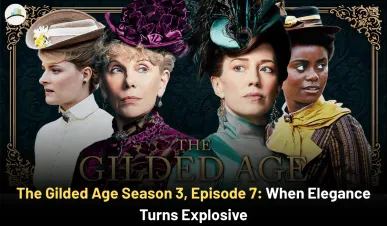
A Social Order Cracks from the Inside
Episode 7 of The Gilded Age Season 3, titled “Ex-Communicated,” does more than just deliver a twist — it tears open the fragile fabric holding together New York’s high society. Ward McAllister’s decision to pen a tell-all memoir isn't just character drama; it’s a calculated commentary on how power, when not acknowledged by its gatekeepers, turns to scandal as its final currency. His exile from Mrs. Astor’s circle is swift and brutal — but the real impact lies in how his betrayal forces the elite to look inward. What happens when your secrets are no longer under your control? The Gilded Age has long glamorized opulence, but this episode makes clear: even the gold is cracking.
Talk about a penultimate episode. #TheGildedAge delivers one of its wildest rides in "Ex-Communicated," with tension that's through the roof and the kind of cliffhanger that's going to keep us up at night.
— Lady Geeks Media (@LadyGeeksMedia) August 4, 2025
Read more in our review: https://t.co/5Td02nO8QW pic.twitter.com/jwdHeiF6zu
Oscar’s Silent Grief Speaks Loudly
Oscar van Rhijn’s storyline quietly steals the emotional weight of the episode. His lover, John Adams, has died — and with him, the last safe space Oscar had to be his full self. In a society where queerness is denied or violently suppressed, Oscar’s grief is laced with guilt, rage, and deep loneliness. Marian's quiet support is a glimmer of hope, but Agnes’ cold detachment reminds us how little room this era gave to live authentically. This subplot may not grab tabloid attention, but it delivers the episode’s most resonant truth: that identity, when hidden long enough, doesn’t disappear — it decays. And Oscar is now left picking through the emotional wreckage.
MORE ARTICLES:
Wealth Can’t Buy Trust — And That’s the Real Crisis
Larry Russell’s success with the copper mines should be a triumph. Instead, it becomes a casualty of class paranoia. Marian ends their relationship after discovering he lied about a night out. She suspects infidelity, but the truth — that he was innocently with a friend — doesn’t matter. What matters is that in this world, mistrust grows in the shadows wealth creates. This is a bigger metaphor for the times: industrial expansion brought power, but it didn’t bring personal security. Everyone’s climbing, but no one’s looking each other in the eye. If love can’t survive upward mobility, neither can this so-called society.
The Final Shot: From Drawing Rooms to Gunfire
Then comes the shot — literally. A gunman enters George Russell’s club and fires at close range. The screen goes black. We don’t know if George survives. What we do know is this: the episode’s final moment strips away any last illusion that this world is insulated. Violence doesn’t just belong to the working class or the frontier — it’s now inside the gentlemen’s sanctum. The symbolism couldn’t be clearer. This era of power built on unchecked capitalism, suppressed truths, and backroom deals has finally invited chaos to its own doorstep.
Why This Episode Matters
This isn't just an escalation for ratings. The Gilded Age is using its climax to confront the myth it was built on — that opulence equals safety, and that money can mask all rot. It can't. Episode 7 tells us that every secret has a shelf life, every institution has a breaking point, and every character — no matter how well dressed — is just one betrayal away from collapse.
As we head into the finale, the question isn't “Who will survive?” It's “What version of this world will be left standing?”



