
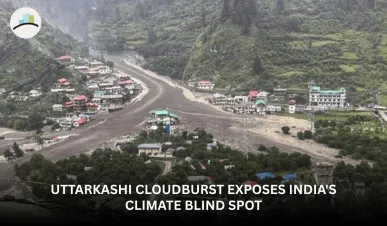
Uttarkashi Cloudburst: A Climate Crisis Warning India Can’t Ignore
The flash floods triggered by a sudden cloudburst in Dharali village, Uttarkashi district of Uttarakhand have once again exposed the fragile relationship between development, climate change, and governance in the Himalayan belt. While immediate headlines focus on casualties and rescue operations, the bigger picture is more unsettling — and largely underreported.
Earlier it was B'bay, Chennai & many other cities
— Sarang Yadwadkar (@SVYadwadkar) August 5, 2025
Yesterday it was Joshimath
Today it is Dharali in Uttarkashi
It's not only nature's fury
It's because of not giving space to water to flow
PMC is committing the same blunder by pinching rivers by 40%
Tomorrow it might be Pune also pic.twitter.com/w1k8ti6ilT
Why Did This Happen? A Climate and Policy Convergence
The cloudburst is not an isolated meteorological event — it’s part of a disturbing pattern of high-intensity, short-duration rainfall events in India’s hill states. Over the last decade, the frequency of cloudbursts in Uttarakhand has increased dramatically, largely due to warming atmospheric conditions over the Himalayas and unchecked environmental degradation.
Key factors contributing to the disaster:
-
Unpredictable Monsoon Shifts: Rising global temperatures are changing monsoon behavior, making rainfall more erratic and concentrated in short bursts.
-
Deforestation and Hill Cutting: Construction of roads, hydropower projects, and real estate along fragile slopes has destroyed natural water absorption capacity.
-
Lack of Early-Warning Infrastructure: Despite ISRO’s satellite capabilities, local alert systems remain underdeveloped or poorly implemented in remote areas like Dharali.
What’s Not Being Discussed Enough?
1. Infrastructure Without Resilience
The Char Dham highway project and similar infrastructure schemes are often blamed for exacerbating landslide and flood risks. Yet, accountability for disaster-resilient design is rarely enforced. Do we build to withstand nature, or just to complete tenders?
2. Silent Economic Fallout
Beyond the loss of life, flash floods cripple local economies — including apple orchards, pilgrimage tourism, and small-scale farming — all central to the region’s livelihood. The cumulative damage to micro-economies remains largely unquantified, but deeply felt.
3. The Cost of Reactive Governance
India’s disaster response, though visibly swift in Uttarkashi thanks to the Army and NDRF, is still largely reactive. There is little public discourse or political will toward long-term adaptation strategies like climate-resilient zoning, mandatory slope audits, or green buffers around rivers.
MORE ARTICLES:
Why Is This Important?
Because what happened in Uttarkashi today could happen in Himachal tomorrow — or in Sikkim, or Assam. As India continues to urbanize and industrialize its hill regions, it is ignoring the ecological ceiling. The risks are no longer theoretical. They’re here. And they’re deadly.
Historical Parallel: The 2013 Kedarnath Tragedy
Just over a decade ago, Uttarakhand witnessed the devastating Kedarnath flash floods that killed over 5,000 people. That disaster, too, was preceded by warnings from ecologists, which were ignored in favor of infrastructure ambitions. If lessons were learned, they were clearly not applied widely enough.
What Hidden Opportunities Exist?
-
Push for Hill-Specific Climate Insurance: With recurring losses, there’s a clear opportunity to build insurance models for hill farmers and tourism stakeholders.
-
Decentralized Weather Alert Systems: Empowering village-level monitoring with real-time updates can reduce casualties dramatically.
-
Reframing Policy: The disaster opens a window for activists and scientists to push for mandatory environmental impact audits for any project above a certain altitude.
Conclusion
The Uttarkashi cloudburst is not just a natural disaster. It is a systemic failure of policy, planning, and foresight — and a wake-up call for how India approaches climate risk in the Himalayas. The mountains may be silent, but they are clearly sending a message. Whether we listen is up to us.



