
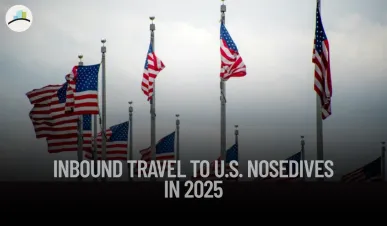
The United States is witnessing a troubling trend in 2025: a sharp decline in inbound tourism that is beginning to ring economic alarm bells. New data reveals that international visitor numbers have dropped significantly this year, with early estimates projecting the total value of international tourism spending to fall below $169 billion — a striking drop from $181 billion in 2024 and a staggering 22% lower than pre-pandemic levels in 2019.
This downturn threatens a sector that has long been a cornerstone of U.S. economic strength. The decline in visitor volume is not only affecting airlines and hospitality but also causing ripple effects across retail, dining, and local transportation sectors that rely heavily on tourist dollars.
Tourism's Economic Significance
Tourism has historically played a pivotal role in the U.S. economy. In 2024 alone, the industry supported more than 20 million jobs and contributed over $585 billion in tax revenues at various levels of government. That figure accounted for nearly 7% of total U.S. government income. With international arrivals down sharply in 2025, industry experts warn of reduced revenues, potential job cuts, and weakened economic momentum — especially in regions highly dependent on foreign tourism such as New York City, Miami, San Francisco, and Orlando.
Travel industry professionals and economists alike have begun to express concern over the prolonged impact of this downturn, particularly if current political and economic policies remain unchanged.
Key Factors Behind the Decline
1. Deteriorating Trade and Diplomatic Relations
One of the major factors contributing to the decline in foreign arrivals is strained international relations, particularly with traditional U.S. allies like Canada, Mexico, and several European nations. The current administration’s tariff-heavy trade policies have created friction that extends beyond goods and services — they’re now affecting people-to-people exchanges as well.
In 2025, Canada — historically the largest source of international tourists to the U.S. — is expected to send over 20% fewer visitors than in previous years. Mexican travel is also forecast to decline sharply, with some travel agencies citing a "chill" in cross-border relations that is discouraging leisure travel.
2. Stricter Immigration and Border Measures
Another key deterrent is the tightening of U.S. immigration and border control policies. Although primarily designed to target illegal immigration, these policies have unintentionally impacted legal travelers as well. Lengthier visa processes, reduced consular staffing, and high-profile reports of detentions or travel denials have created an atmosphere of uncertainty for tourists planning visits.
Tourism analysts note that travelers from countries in Asia, the Middle East, and Latin America are particularly affected. The perception of being unwelcome, combined with logistical hurdles, is driving potential visitors to alternative destinations in Europe, Southeast Asia, or Latin America.
3. Negative Perception of the U.S. Travel Experience
Beyond policy, perception matters. Several recent global surveys have indicated a decline in how international travelers view the United States. The country's image as a welcoming, culturally rich, and tourist-friendly destination has suffered. Travelers from nations such as Germany, Japan, and the United Kingdom have expressed growing concerns over personal safety, rising domestic polarization, and what they perceive as a decline in customer service standards.
In an increasingly competitive global travel industry, even subtle shifts in perception can lead to massive changes in booking patterns. Nations such as Spain, Canada, and Thailand are capitalizing on the opportunity to attract tourists disillusioned with the U.S.
Industry Reactions and State-Level Initiatives
While the federal government has remained relatively silent on the issue, several U.S. states and local tourism boards are taking proactive steps to counter the decline. From California to Florida, campaigns are being launched to encourage international travel. These initiatives include streamlined airport processes, multilingual visitor support, and regional advertising campaigns targeting key overseas markets.
Moreover, major cities are investing in public infrastructure, cultural festivals, and convention incentives aimed at attracting both leisure and business travelers.
The travel industry, meanwhile, is lobbying Washington for clearer visa guidance, restoration of key international marketing programs, and improved diplomatic communication. Organizations such as the U.S. Travel Association argue that every million international visitors support tens of thousands of American jobs and contribute billions to the economy.
Looking Ahead: Is Recovery Possible?
The outlook for inbound tourism to the U.S. remains uncertain. Much will depend on the geopolitical climate, economic cooperation with key countries, and internal policy shifts. A change in leadership or diplomatic tone could signal renewed international confidence, but such shifts take time.
Some experts believe that while 2025 may close with disappointing figures, there's potential for rebound in 2026 if targeted measures are taken soon. These could include reopening international promotional offices, simplifying visa procedures, and working to restore the U.S. brand as a desirable global destination.
Conclusion
The sharp drop in inbound tourism to the United States in 2025 is more than just a seasonal slump — it's a reflection of deeper structural and political issues that are shaping global perceptions of the country. As international travel continues to recover in many parts of the world, the U.S. risks being left behind unless swift and strategic action is taken.
Tourism is more than just a luxury industry — it’s a critical component of economic resilience, cultural diplomacy, and international collaboration. For the U.S., the path forward will require policy alignment, outreach, and a recommitment to being a welcoming gateway to the world.
Disclaimer
This article is intended for informational purposes only. It does not constitute travel advice or economic forecasting. Readers are encouraged to consult official data and expert analysis for decision-making.
Source
Original reporting by Financial Express
More Articles:



