
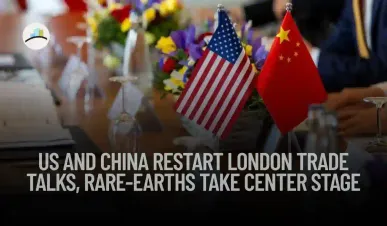
High-level trade negotiations between the United States and China are set to resume in London on Monday, June 9, 2025. The talks follow a 90-day tariff ceasefire agreed upon in Geneva and will focus heavily on rare-earth mineral export controls and semiconductor restrictions.
Context: From Tariff Truce to London Table
In May, both nations agreed to a temporary pause in tariff escalation: the U.S. reduced its rate from 50% to 30%, while China eased its counter-tariffs from 20% to 10%. This Geneva truce facilitated fresh dialogue and led to a rare phone call between Presidents Trump and Xi Jinping, who reportedly agreed to resume critical mineral shipments to the U.S.
Rare-Earths: A Strategic Focus
Rare-earth elements—such as neodymium, terbium, and dysprosium—are crucial to electric vehicles (EVs), advanced electronics, and defense systems. China controls over 85–90% of global production and processing, making it a linchpin in global supply chains .
Also Read:
In April, China imposed new licensing restrictions on rare-earth exports, disrupting auto and aerospace supply chains. The impact has been significant: exports rose 23% in May to nearly 5,865 tons, yet remain well below last year’s levels. In response, Beijing granted temporary export licenses to suppliers for U.S. automakers like GM, Ford, and Stellantis, with some valid for six months .
Top trade negotiators from the US and China are set to hold fresh talks in London on Monday, offering a glimmer of hope that the world’s two largest economies can defuse tensions over Chinese dominance in rare-earth minerals https://t.co/sZGZwRcODj
— Musadaq Zulqarnain (@MusadaqZ) June 9, 2025
London Agenda and Delegations
Top-level delegations will represent both nations:
United States –
Treasury Secretary Scott Bessent
Commerce Secretary Howard Lutnick
U.S. Trade Representative Jamieson Greer
China –
Vice Premier He Lifeng, along with officials from the Ministry of Commerce and State Council .
They are expected to cover rare-earth export license procedures, extensions to existing export curbs (particularly in semiconductors and jet engines), and possible truce extensions. China is also fast-tracking applications and improving export license transparency in communication with partners .
Industry and Market Reactions
Global automakers are sounding alarms. European and U.S. factories have reported shutdowns due to rare-earth shortages, prompting urgent appeals for resumption of material flows . Investors remain cautiously optimistic: U.S. stock futures dipped only slightly ahead of the talks, while commodity markets held steady .
A successful agreement could not only ease EV and defense supply chains but also restore broader economic confidence amid trade uncertainty.
Challenges and Risks
Despite progress, several hurdles remain:
-
China maintains stringent licensing controls, with geopolitical motives cited in export delays .
-
Disputes over semiconductor equipment and AI chip export bans persist.
-
Broader tensions—Taiwan, student visa bans, and national security—could overshadow trade talks .
Looking Ahead
The 90-day truce is due to expire in mid-August. If London talks lead to extended stability and clearer rare-earth export terms, the truce may be renewed. Failure to deliver tangible outcomes, however, could lead to renewed tariffs or escalation—disrupting global growth and supply chains.
Source: Bloomberg – US, China to Resume Trade Talks With Focus on Rare Earths



