
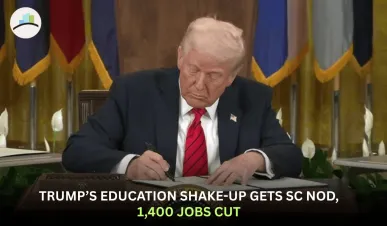
Trump’s Education Overhaul Gets Supreme Court Nod—But Is It a Win or Warning for U.S. Schools?
In a landmark decision with sweeping consequences, the U.S. Supreme Court has given the green light to the Trump administration’s plan to restructure the Department of Education. Framed by supporters as a move to reduce bureaucracy and empower parents, the initiative will result in the elimination of approximately 1,400 federal education jobs—a staggering shake-up in the oversight of American schooling.
While hailed as a “victory” for school choice advocates and critics of federal overreach, the dismantling of these roles also raises red flags around educational equity, state-level capacity, and the future of federal support for underprivileged students.
Supreme Court Allows Trump To Lay Off Nearly 1,400 Education Department Employees, per AP. pic.twitter.com/HFAkQWntmF
— Revamped | Career & Workplace Development (@RevampedCP) July 14, 2025
Why This Happened: Politics, Power, and Public Sentiment
-
The populist narrative around ‘parental control’
The Trump administration has capitalized on rising discontent over perceived ideological bias and inefficiency in the education system. By reframing the issue as one of "parental rights" versus "federal control," the restructuring gained political traction among conservatives. -
Long-standing GOP skepticism of federal education authority
Republicans have long argued that education is best handled at the state and local levels. This ruling finally offers legal cover to shift responsibility away from Washington and back into state hands.
What’s Not Being Discussed Enough: Who Gets Left Behind
-
Loss of oversight may hurt vulnerable students
Federal education roles often support Title I programs, civil rights enforcement, and disability services. With mass job cuts, oversight of equity-based programs could weaken, widening the achievement gap. -
States may not be ready for the burden
Not all states have the administrative capacity or budgets to absorb the functions being offloaded. This could lead to patchwork policies, with students in some states better served than others.
MORE ARTICLES
Economic & Political Implications: A New Education Industry Era
-
Private education sector may boom
Charter schools, private institutions, and ed-tech companies stand to gain. With less federal scrutiny and more state autonomy, alternative education providers may flood the market, backed by newly empowered school boards. -
Red state vs. blue state divergence widens
Education quality could increasingly depend on geography. Progressive states may preserve federal standards through state-level action, while conservative ones embrace deregulation—furthering the education divide.
Historical Parallel: Reagan’s 1980s Devolution Push
This move echoes Ronald Reagan’s attempts to shrink federal influence across agencies in the 1980s. Then too, education cuts were framed as fiscal responsibility. But the long-term fallout—gutted school oversight and uneven quality—took years to undo.
Hidden Opportunity: Rethinking Education Accountability
-
Chance to modernize with tech and local innovation
States could now pilot localized education models, especially those that integrate AI, hybrid learning, and competency-based evaluations—if executed equitably. -
Potential for grassroots community reform
With federal structures receding, communities may organize more actively to demand transparency, inclusive curriculums, and accountable school governance.
The Bottom Line: Reform or Retrenchment?
Supporters hail the Supreme Court ruling as a victory for parental control and educational freedom. But without strong guardrails, the policy risks turning decentralization into deregulation—leaving millions of students at the mercy of underprepared state systems and market forces.



