
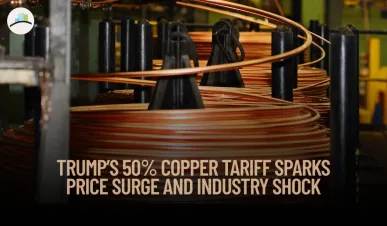
the Trump administration announced a sweeping 50% tariff on imported copper and copper semi-finished products, scheduled to take effect August 1. The move invokes Section 232 of the Trade Expansion Act of 1962, a national security clause allowing tariffs on imports deemed critical to defense or industrial security. Copper, essential to key sectors such as semiconductor manufacturing, aircraft production, missile defense, lithium-ion battery development, and advanced communication systems, was identified as a strategic resource warranting protection.
The tariff applies broadly, covering raw copper and semi-finished goods—including wires, sheets, tubes, and plates—components integral to military supply chains and high-tech manufacturing. The Copper Development Association, representing the majority of U.S. copper semi-producers, has highlighted the vital role these products play in national security and economic competitiveness.
More Articles:
Immediate Market Reaction and Price Volatility
Financial markets reacted sharply to the announcement. U.S. copper futures surged 13% in a single day, the most significant spike since 1968, reaching a record high above $5.60 per pound. This rapid increase reflects market participants scrambling to secure supplies ahead of the tariff’s enforcement, anticipating higher costs on imports.
While the price surge benefits U.S. producers in the short term, it also threatens to escalate input costs for downstream industries. Sectors reliant on copper—from automotive manufacturers to electronics producers and construction firms—face elevated expenses, which could translate to higher prices for consumers or squeezed profit margins. Analysts warn that sustained high prices may lead to reduced demand, or “demand destruction,” dampening growth prospects.
Challenges in Boosting Domestic Production
The tariff is intended to incentivize greater domestic copper production and reduce reliance on imports, which currently satisfy roughly half of U.S. copper demand. However, increasing domestic output faces significant hurdles. U.S. copper mining capacity has declined by about 20% over the past decade, hampered by regulatory, environmental, and investment challenges. Developing new mines or expanding existing facilities requires long lead times, often a decade or more, before commercial production begins.
The tariff signals a long-term strategic commitment to revitalizing the domestic copper industry. Yet in the near term, the U.S. will continue to depend heavily on imports, potentially at higher cost.
Global Trade and Diplomatic Fallout
International copper producers have expressed strong concerns. Chile, the world’s largest copper exporter and a free trade partner with the U.S., condemned the tariff as unjustified, warning that it could deter investment in an industry already vulnerable to market volatility. Zambia, a key African producer, has appealed for exemption, citing the critical role of copper exports in financing infrastructure projects like the Lobito Corridor, which links to global markets.
These diplomatic tensions underscore the risk that tariffs may provoke retaliatory measures or disrupt established trade flows, exacerbating supply chain uncertainties.
Balancing National Security and Economic Impact
The administration’s tariff reflects a prioritization of national security considerations over short-term economic pain. By shielding critical supply chains and stimulating domestic production, policymakers aim to enhance U.S. strategic autonomy. However, the resulting rise in copper prices imposes costs on manufacturers and consumers alike.
The challenge ahead lies in managing this trade-off: ensuring that national security objectives do not unduly stifle economic growth or competitiveness. Success will require complementary policies supporting mining expansion, innovation in material efficiency, and development of alternative supply sources such as recycling or substitution technologies.
Trump Unveils Surprise 50% Tariff on Copper to Boost U.S. Production https://t.co/bStydlGWpr via @MGDMEDIA1
— MGD MEDIA (@MGDMEDIA1) July 11, 2025
Procapitas Insight: A Call for Measured Policy
While protecting strategic industries is vital, abrupt tariff impositions risk unintended economic consequences. A phased, transparent approach coupled with incentives for domestic production and investment may better balance security goals with market stability. The global copper market’s interdependence means that cooperation and dialogue with key trade partners will also be crucial to avoid prolonged trade disputes.
Disclaimer:
This article is intended for informational purposes only and does not constitute investment advice. Procapitas does not provide personalized financial recommendations. Always consult a licensed financial advisor before making investment decisions. Information is based on publicly available sources as of June 2025 and Procapitas’ independent research and analysis.



