
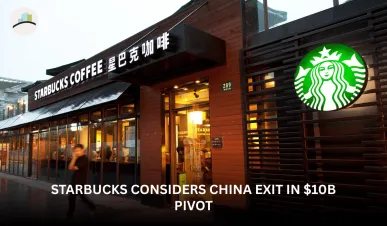
Starbucks' China operations are drawing takeover interest at valuations reaching up to $10 billion, signaling not just a financial opportunity but a broader economic story about brand resilience, strategic decoupling, and the evolving nature of Western business in China.
According to CNBC, the coffee giant’s China business is receiving strong bids, even as U.S.-China relations remain tense and consumer patterns continue to shift. This moment is more than a deal—it’s a barometer for how deeply entrenched American brands are in the Chinese economy, and how investors are recalibrating risk and opportunity in a volatile global landscape.
Starbucks - PE breakup? @Starbucks
— GlobalMarketsX (@GlobalMarketsX) July 9, 2025
Starbucks China attracts bids valuing the coffee chain at up to $10 billion, sources say @CNBC https://t.co/8oeymRISVD
Why This Is Happening Now
Starbucks China has long been considered the crown jewel of the company’s international portfolio. With more than 6,500 stores in the country—making it the second-largest market after the U.S.—China accounts for nearly 25% of Starbucks' global revenue.
So why sell—or even consider bids—now?
-
Rising operational complexity: Doing business in China has become more politically sensitive. Data privacy rules, labor scrutiny, and shifting cultural dynamics are forcing Western brands to reevaluate direct exposure.
-
Capital unlocking: If Starbucks offloads part or all of its China stake, it can reinvest in higher-growth areas like India, Southeast Asia, or even back into U.S. automation and AI-led store formats.
-
Local competition is catching up: China’s homegrown coffee chains, especially Luckin Coffee, have rebounded and are expanding aggressively with localized pricing and tech-driven ordering. Starbucks needs capital and flexibility to innovate at speed.
What’s Not Being Discussed Enough
1. This Could Be the Start of Western Partial Exit from China
Starbucks may not leave entirely, but its openness to bids is part of a larger trend: Western companies are increasingly opting for strategic partnerships, partial sales, or franchise models to reduce direct control and risk in China, while maintaining brand presence.
2. Consumer Sentiment in China Is Shifting
While Starbucks is still popular, nationalism-fueled buying behavior—encouraged subtly through social media and policy signals—means younger consumers are increasingly choosing local over global. This quiet change in sentiment could erode premium pricing over time.
3. Who Buys Matters More Than the Price
If a state-linked bidder wins the deal, it signals stronger government influence over consumer infrastructure. If a private consortium or tech giant like Alibaba backs the deal, the outcome may favor a digitally integrated Starbucks-China 2.0, akin to what Yum China did with KFC and Pizza Hut.
MORE ARTICLES:
Hidden Risks and Opportunities
Risk: Brand Control Could Erode
Even with licensing agreements or retained equity, Starbucks could lose day-to-day influence over how its brand is presented in China, especially as AI and personalization algorithms drive consumer experience.
Risk: Financial Overreliance on U.S. Market
Selling its fastest-growing international asset could increase Starbucks’ dependence on a mature and saturated North American market—making it vulnerable to domestic shocks.
Opportunity: Stronger Local Adaptation
A local buyer could bring deeper cultural alignment, logistics advantages, and faster digital integration—making the China business leaner and more responsive to market trends.
Opportunity: Investor Repositioning
This deal could unlock long-term value for Starbucks shareholders and give institutional investors a rare exposure to a premium consumer asset in China, without the political baggage of a Western parent company.
Historical Parallel: The Yum China Precedent
When Yum! Brands spun off its China operations in 2016, it was seen as risky. But Yum China adapted quickly, went public, and is now one of the most successful fast-food brands in Asia. Starbucks may be testing the same playbook: decentralize, localize, capitalize.
Why It Matters
Starbucks China isn’t just about lattes—it’s about how foreign companies navigate the fine line between global ambition and local adaptation. If this deal goes through, it could mark the start of a new era where Western brands stop owning China and start licensing it.
For companies eyeing China in 2025 and beyond, the Starbucks deal could be a model or a warning.



