
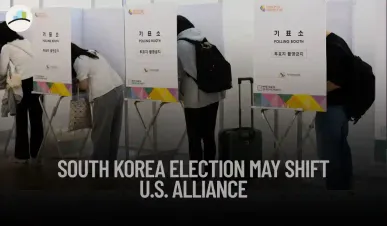
South Korea is preparing for a high-stakes presidential election on June 3, 2025, and the outcome could significantly reshape the country's foreign policy direction, especially its relationship with the United States. The vote comes at a pivotal time as Seoul faces complex regional challenges and shifting global alliances.
Lee Jae-myung Emerges as Frontrunner with Different Diplomatic Vision
Lee Jae-myung, the leading liberal candidate, is on track to win the presidency, according to most polls. His expected victory would mark a clear break from the more conservative and Washington-aligned stance of recently ousted President Yoon Suk Yeol.
While Lee has historically supported closer engagement with North Korea, and a more cautious stance toward Japan and China, he’s also been refining his message during the campaign. Recently, he has voiced strong support for the U.S.-South Korea alliance and emphasized the importance of trilateral cooperation with both Washington and Tokyo—likely in a bid to appeal to moderates and reassure allies abroad.
More Articles:
Concerns Over Lee’s Policy Consistency Linger in Washington
Despite his current pro-U.S. messaging, there’s concern in D.C. policy circles about whether Lee will stick to this course if elected. His earlier positions, which leaned toward diplomacy with Pyongyang and a softer approach on Beijing, contrast sharply with the more hardline strategies favored by the U.S. in recent years.
Lee has openly expressed admiration for former U.S. President Donald Trump, though his views remain cautious when it comes to future cooperation. His vow to reopen communication lines with North Korea is seen as a return to past liberal policies, but worsening relations with Pyongyang—and its closer military ties with Russia—could complicate those ambitions.
Notably, Lee has ruled out any push to redeploy U.S. tactical nuclear weapons or to develop an independent nuclear arsenal—positions that set him apart from the defense-heavy policies under the previous administration.
South Korea is set to break a record in early voting as more than 12 million voters cast their ballot in advance of the country’s upcoming presidential election. pic.twitter.com/29PB2Mm68a
— True Vine9ja (@TrueVine9ja) May 30, 2025
What’s at Stake for U.S.-Korea Relations
Lee’s approach, if implemented, could significantly alter how South Korea engages with the U.S. and its strategic partners in the Indo-Pacific. While he’s publicly committed to the alliance, his broader foreign policy hints at a more autonomous regional role for South Korea—one less reliant on Washington’s lead.
This shift could reshape how Seoul approaches China, navigates tensions with Japan, and responds to threats from North Korea. American policymakers are watching closely, as the election outcome may influence regional defense postures, trade priorities, and nuclear diplomacy.
Absolutely! Here's the revised disclaimer including both your requested style and proper source attribution:
Disclaimer
This article is intended for informational purposes only and does not constitute investment, legal, or political advice. Readers are encouraged to conduct their own research before making any decisions.
The information presented is based on reporting from Reuters, published on May 30, 2025. All rights to original reporting belong to the respective source.
Source:
Reuters - South Korea's presidential election set to reshape policies for key U.S. ally



