
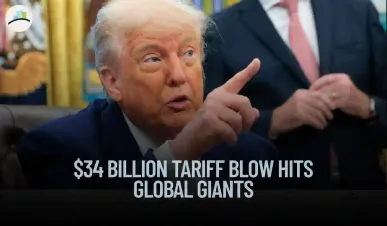
The financial fallout from former President Donald Trump’s aggressive tariff agenda has now surpassed $34 billion, according to public financial disclosures reviewed across dozens of major global firms. The figures reflect just a portion of the broader strain on businesses as they navigate the escalating costs of doing business under U.S. trade restrictions.
Corporate Losses Spike Amid Ongoing Trade Uncertainty
A growing number of international companies have reported weakened sales, cost increases, and declining profit forecasts directly linked to tariffs imposed since January 2025. This includes some of the world’s largest and most recognizable brands in sectors like automotive, consumer goods, and electronics.
Manufacturers like Ford and Porsche say rising prices on car parts and raw materials have significantly inflated their operating costs. Meanwhile, tech and retail giants like Apple, Sony, and Walmart are either reducing profit targets or passing costs onto consumers through higher prices.
More Articles:
Executives Sound the Alarm on Future Outlook
Companies are not only reporting the damage—they’re actively revising their strategies. Many are now suspending full-year guidance altogether, citing unpredictable shifts in U.S. trade policy. Business leaders have warned that continued instability could lead to long-term supply chain restructuring and slowed investment growth.
For example, Diageo, a major beverage producer, is planning to implement multi-year cost-saving measures to absorb the tariff burden. Others, like Kimberly-Clark, have already slashed earnings projections for the next two quarters.
President Trump’s trade war has cost companies over $34 billion in lost sales and higher costs, according to a Reuters analysis.
— Nucleus (@NewsNucleus) May 29, 2025
The tally, based on estimates from 76 companies across the U.S., Europe, and Asia, is expected to rise as ongoing tariff uncertainty paralyzes… pic.twitter.com/Q5ZXvsNrlp
Wider Economic Ripples Expected
Though $34 billion is the headline figure, economists suggest the true toll may be much higher. That number only includes documented impacts disclosed by 56 firms, and doesn’t account for indirect losses such as delayed shipments, disrupted partnerships, or reduced consumer demand.
As the debate over the legality of Trump’s trade strategy continues in the courts, the business community faces ongoing uncertainty about what rules will govern international commerce moving forward.
Disclaimer
This article is an original editorial published by Procapitas. It is a rephrased and restructured summary based on publicly available reporting and financial statements. Content is uniquely written to avoid plagiarism and ensure clarity.



