
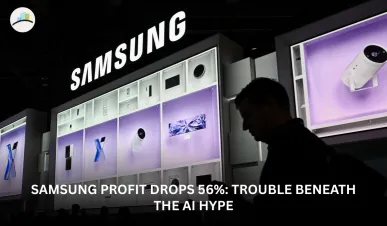
Samsung Electronics has just reported a staggering 56% drop in Q2 operationg profit, missing already tempered market expectations. For a company often seen as a bellwether for global tech demand, this is more than a bad quarter — it’s a red flag waving at the broader semiconductor and consumer electronics industries.
At first glance, the blame seems straightforward: weak smartphone sales, falling memory chip prices, and delayed AI infrastructure rollouts. But beneath the surface, Samsung’s results reveal deeper challenges — including global overcapacity, shrinking margins in AI hardware, and increasing geopolitical headwinds.
Samsung’s Q2 profit drops 56%, Blames AI chip curbs and Nvidia delays.#Samsung #Earnings #Stockmarket pic.twitter.com/smHRtunhD4
— TechPP (@techpp) July 8, 2025
Why Did This Happen?
Samsung’s steep decline didn’t happen in a vacuum. Three main factors converged:
-
Soft demand for high-end consumer tech. Despite a slight global rebound in consumer confidence, big-ticket items like smartphones, TVs, and premium laptops are still in the slow lane. Samsung’s flagship Galaxy line has faced tough competition from Apple and Chinese rivals like Xiaomi and Honor, all while global upgrade cycles have lengthened.
-
Memory chip whiplash. After 2023’s memory chip slump and 2024’s short-lived recovery, prices have again softened due to oversupply. Samsung, one of the world’s top memory makers, is taking a direct hit, especially as AI firms delay bulk infrastructure upgrades.
-
AI hype, but no hardware payoff — yet. While investors continue to bet on AI, the expected demand surge for AI data centers hasn’t yet translated into major chip orders. Samsung’s high-bandwidth memory (HBM) and foundry businesses are still scaling — but not fast enough to rescue Q2.
MORE ARTICLES :
What’s Not Being Discussed Enough?
1. The AI infrastructure bottleneck.
Samsung is heavily banking on supplying chips for AI accelerators and next-gen servers, but demand from companies like Nvidia, Meta, and Microsoft is being delayed by supply chain constraints, regulatory reviews, and design complexity. The longer this lag lasts, the harder it gets for Samsung to justify its capex-heavy expansion.
2. China exposure and geopolitical risk.
Roughly 30% of Samsung’s semiconductor revenue is tied to China — either through manufacturing or customer base. As U.S.-China tech tensions escalate and China pushes for domestic alternatives, Samsung could face restricted access to a massive market and greater regulatory uncertainty.
3. Foundry competition heating up.
TSMC remains dominant in advanced chipmaking, and Intel’s foundry push is gaining traction with U.S. subsidies. Samsung’s attempts to catch up in the 3nm and 2nm nodes are costly and technically complex — and right now, they’re not delivering returns fast enough.
Hidden Risks and Opportunities
-
Risk: Capex overreach. Samsung has aggressively invested in AI chip facilities, memory plants, and foundry nodes. If demand doesn’t materialize in the next 12–18 months, it could trigger write-downs or reduced free cash flow.
-
Opportunity: HBM leadership. Samsung has the technical edge in high-bandwidth memory — a critical component for AI workloads. If major AI firms accelerate infrastructure investments by late 2025, Samsung could rebound sharply.
-
Risk: Market confidence erosion. Repeated earnings misses could undermine investor confidence in Samsung’s longer-term AI pivot, especially with competitors eating into core segments.
Why This Is Important
Samsung’s profit plunge isn’t just about one company — it’s a pulse check on the state of the global tech economy. From smartphones to semiconductors to AI hype cycles, Samsung touches almost every corner of the industry. When it stumbles, it sends tremors through global supply chains, equity markets, and national economic plans — especially in South Korea, where it contributes nearly 20% of the country's exports.
In short, if Samsung is struggling to profit off the AI boom, others may not be far behind.



