
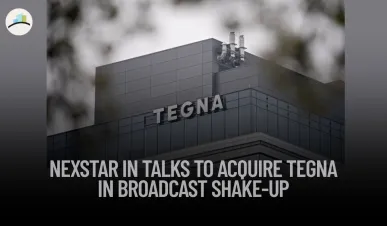
Nexstar Media Group, the largest owner of local TV stations in the United States, is in advanced discussions to acquire Tegna Inc., a rival broadcaster with 64 television stations across 51 markets. If completed, this deal would represent one of the largest consolidation plays in the traditional TV broadcasting sector in recent years.
More Articles:
Tegna’s stock saw a sharp surge of nearly 30% following the news, reflecting investor optimism over a potential acquisition premium and industry consolidation momentum. Nexstar’s share price remained steady, suggesting market confidence in the company's long-term strategy and financial discipline.
This potential transaction would mark Nexstar’s most significant acquisition since its 2019 purchase of Tribune Media. That deal propelled Nexstar to the top of the local broadcasting food chain — a position it now seeks to solidify by bringing Tegna under its wing.
Deregulation Sets Stage for Mega‑Deal
The groundwork for such a major transaction has been laid by a shifting regulatory environment. The Federal Communications Commission (FCC), now operating under a more business-friendly posture, has loosened its stance on media ownership limitations. The recent removal of the "Top Four" rule — which previously barred a company from owning more than one of the top four TV stations in a given market — has opened the door to large-scale consolidations.
Additionally, the possible elimination of the UHF discount, which currently allows broadcasters to exceed national reach limits through technical classification loopholes, is creating a window of opportunity for companies like Nexstar to move quickly before the regulatory pendulum swings back. Nexstar appears to be capitalizing on this deregulatory moment, using its current financial strength and political timing to pursue strategic expansion.
Scale, Synergies, and Strategic Gains
From a strategic standpoint, the potential acquisition of Tegna offers Nexstar significant value. Tegna owns a diversified portfolio of stations in key regional markets, including Washington, D.C., Atlanta, and Seattle. Moreover, it brings a growing digital presence with streaming assets like True Crime Network and Twist.
Nexstar, already known for its efficient operating model and cost discipline, would likely seek to streamline overlapping operations, consolidate back-end functions, and centralize advertising and content management. The synergy opportunities are substantial — not just from a cost-saving perspective, but also from an audience-reach and content-monetization standpoint.
For advertisers, a combined Nexstar-Tegna platform could offer enhanced scale across both traditional and digital mediums, improving reach and targeting capability. This could be particularly valuable in an era where local television is competing against digital-first platforms for ad dollars.
Market and Investor Implications
This deal, if finalized, would be a defining moment for the U.S. broadcast TV industry. It represents a broader shift toward consolidation as traditional broadcasters aim to stay competitive against streaming services and tech platforms.
From an investor’s perspective, the deal could signal renewed profitability in the legacy media space — not through organic growth, but through structural efficiency and market consolidation. For Nexstar, which has demonstrated a track record of integrating large media assets successfully, this move could boost both earnings potential and strategic positioning.
The transaction could also pressure other players in the market, such as Sinclair Broadcast Group and Gray Television, to explore similar deals or partnerships to keep pace with Nexstar’s growing scale.
Nexstar, the largest TV station operator in the US, is in talks to acquire competitor Tegna, according to sources https://t.co/B9mMCiX6Ds
— Richard Washington III (@RW3TV) August 8, 2025
Procapitas Perspective
Nexstar’s pursuit of Tegna is more than a simple acquisition — it’s a statement about where legacy media is headed. While streaming platforms continue to dominate headlines, Nexstar is betting that local broadcast TV, when scaled and integrated effectively, still has significant financial and strategic value.
The combination of deregulatory momentum, attractive target valuation, and synergy potential makes this a well-timed move. However, challenges remain. Regulatory approval, especially in politically sensitive markets, could delay or reshape the structure of the deal. Nexstar may also face scrutiny over media plurality and market concentration, particularly in overlapping regions.
Nevertheless, this potential deal underscores a critical industry truth: in an evolving media ecosystem, scale and efficiency are not optional — they’re survival imperatives.
Disclaimer:
This article is for informational purposes only and does not constitute investment advice or a recommendation to buy or sell any securities. Procapitas does not provide personalized financial advice. All investment decisions should be made in consultation with a licensed financial advisor. The information presented is based on publicly available sources and Procapitas’ independent research and analysis, which are believed to be reliable but are not guaranteed for accuracy or completeness.



