
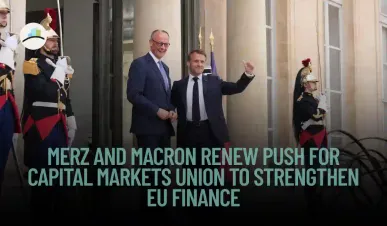
German Chancellor Friedrich Merz and French President Emmanuel Macron have launched a fresh initiative to end Europe's long-standing capital market fragmentation. Their goal is to revive the Capital Markets Union (CMU) plan, aiming to enhance investment opportunities, unify regulations, and boost the EU's global competitiveness.
The renewed focus comes amid growing concerns about Europe’s reliance on bank lending, limited capital mobility, and the increasing influence of U.S. and Chinese financial systems.
Also read:
Background: What is the Capital Markets Union?
First introduced in 2015 by the European Commission, the Capital Markets Union (CMU) was designed to create a single, integrated capital market across EU member states. Its core objectives include improving funding access for small and medium-sized enterprises (SMEs), encouraging retail investment, and diversifying funding sources beyond traditional bank loans.
Despite early momentum, the CMU has seen little real progress due to national regulatory differences, lack of political consensus, and diverging economic priorities across EU countries.
Why the Renewed Momentum?
Friedrich Merz, recently elected as German Chancellor, joined Macron during a high-level summit in Brussels where both leaders emphasized the urgent need to revitalize the EU’s financial landscape. The decision follows mounting economic pressures, including:
-
Weak eurozone growth forecasts
-
Growing dependence on non-European investors
-
The need for more resilient financing options during crises
Merz stated that Europe cannot afford to fall behind in global capital competitiveness, adding that a unified capital market is essential for economic resilience.
Objectives of the Franco-German Initiative
The revived CMU plan focuses on removing regulatory bottlenecks and creating common standards to facilitate cross-border investment. The main priorities outlined include:
-
Harmonizing financial rules and reporting standards across EU countries
-
Creating centralized mechanisms for stock exchange operations
-
Enhancing access to private equity and venture capital for startups
-
Establishing safeguards for retail investors across all member states
The initiative also aims to support green and digital transformation by promoting sustainable investment products and cross-border digital finance platforms.
Investor and Market Reaction
European stock markets reacted positively following the announcement. The Euro Stoxx 50 gained 0.9 percent, while shares of European financial service providers experienced moderate gains.
Eleni Papadopoulos, Chief European Analyst at BlueVest Capital, commented that while the renewed push is welcome, implementation is the real test. Investors want to see concrete progress, not just political alignment.
Potential Roadblocks
Even with Germany and France leading the charge, several hurdles remain:
-
Resistance from smaller EU states concerned about losing regulatory autonomy
-
Disagreements over taxation frameworks and financial transparency standards
-
Reluctance from national stock exchanges to consolidate or cooperate
-
Post-Brexit complications excluding the UK from contributing to the union
Critics argue that unless legally binding frameworks are enforced, this iteration of the CMU may suffer the same fate as its predecessors.
What Happens Next?
Merz and Macron are expected to submit a joint proposal to the EU Finance Ministers’ Council in July. If approved, the European Commission may begin drafting legislation by the end of 2025. The success of the initiative will largely depend on support from countries such as Italy, Spain, and the Netherlands.
Source: Bloomberg – Merz Pledges New Bid with France to End Capital Markets Impasse



