
India’s June PMIs Confirm Sustained Economic Momentum
India’s economic trajectory showed further resilience in June 2025, with the latest flash Purchasing Managers’ Index (PMI) data reflecting sustained strength across both manufacturing and services sectors. The composite PMI stood at a robust 60.9, extending a nearly three-year run of expansion. Services PMI came in at 60.4, while manufacturing reached 58.5—both well above the 50-mark that separates expansion from contraction.
This performance is not just a headline statistic. It points to the consistency of India’s domestic and external demand, even amid global uncertainties. The figures suggest that India is not merely riding a post-pandemic rebound but potentially undergoing a structural upgrade in productivity, exports, and employment.
More Articles:
Record Job Creation Signals Growing Capacity Needs
Perhaps the most striking aspect of the June flash report was the labor market data. Both the manufacturing and services sectors reported the strongest hiring activity since 2006, driven by growing backlogs and new business inflows. This isn’t just catch-up hiring from pandemic losses—firms are expanding teams to meet rising order volumes and delivery deadlines.
Such job growth across the formal sector points toward the early signs of labor market normalization in India. If sustained, it could mark a turning point in wage growth and consumption patterns in Tier 2 and Tier 3 cities, which are increasingly becoming hubs of business process outsourcing and contract manufacturing.
Export Orders Deliver the Real Surprise
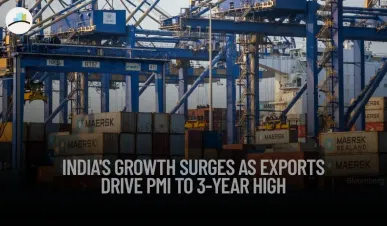
India's export engine fired on all cylinders in June. Flash PMI surveys showed that new export orders rose for the 22nd straight month, with overseas demand remaining strong for both goods and services. While the pace was slightly slower than in May, it’s the breadth of the export expansion that is noteworthy.
From engineering goods and chemicals to financial services and IT-enabled platforms, Indian firms are supplying a broader array of products and services to new global markets. Latin America, Southeast Asia, and Eastern Europe emerged as bright spots in the latest export order data. This diversification supports India’s positioning in the “China+1” strategy adopted by global corporates looking to derisk supply chains.
Cooling Inflation, But Price Pressure Lingers
On the pricing front, the PMI data indicated that both input and output price pressures remained elevated in June. However, there was a modest cooling in cost acceleration compared to May. Most firms managed to pass on increased costs to customers, suggesting stable demand and relatively healthy pricing power.
This is a subtle but important dynamic: while inflation is not abating rapidly, it’s also not spiraling. The Reserve Bank of India is likely to view this as a reason to hold rates steady, especially with global interest rate paths uncertain and oil prices climbing due to geopolitical risks.
India’s Macro Story Gains Further Validation
The June PMI data aligns closely with prior months’ momentum, reinforcing the case for India as a global economic outlier in 2025. Unlike many emerging markets facing growth fatigue or capital outflows, India’s economic cycle is being sustained by a combination of:
-
Robust domestic consumption
-
Strong infrastructure investment
-
Increasing participation in global exports
-
A shift in formal employment dynamics
This convergence of factors is rare—and, when backed by monetary and fiscal discipline, lays the groundwork for multi-year expansion.
India Growth Firm as Export Orders Soar in June, Flash PMIs Show
— Mountain Rats (@mountain_rats) June 23, 2025
Procapitas Perspective: From Momentum to Structural Growth
The significance of India’s PMI performance extends beyond near-term numbers. It signals deep changes in how India’s economy operates and how the world interacts with it.
First, the export base is no longer narrow or IT-centric. Manufacturing exports—from textiles to heavy industry—are rising, helping India plug into global production networks.
Second, labor demand is transitioning. For the first time in nearly two decades, Indian firms are hiring not just to reduce backlogs but to prepare for sustained demand growth. This can support long-term formalization of jobs and boost income levels across middle-class and lower-income households.
Third, India's business confidence remains decoupled from global pessimism. While many developed economies are slowing or stagnating, Indian firms are building, hiring, and expanding. That divergence gives investors a compelling narrative—and potentially a unique risk-reward profile in global portfolios.
Disclaimer:
This article is intended for informational purposes only and does not constitute investment advice. Procapitas does not provide personalized financial recommendations. Always consult a licensed financial advisor before making investment decisions. Information is based on publicly available sources as of June 2025 and Procapitas’ independent research and analysis.



