
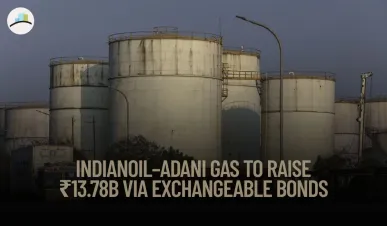
IndianOil–Adani Gas Private Limited, a 50:50 joint venture between Indian Oil Corporation and Adani Total Gas, is set to raise up to ₹13.78 billion (approximately USD 161 million) through an issuance of exchangeable bonds. The bond issuance marks one of the most substantial hybrid debt financings in India’s energy and infrastructure sector this year, signaling renewed investor appetite for structured instruments amidst volatile global markets.
This strategic fundraising comes at a time when the JV is accelerating its expansion of city gas distribution (CGD) networks across India—an initiative closely aligned with the Indian government’s broader decarbonization and energy access targets.
More Articles:
Why Exchangeable Bonds? A Strategic Tool for Flexible Financing
The use of exchangeable bonds offers a compelling blend of benefits to both the issuer and investors. For the IndianOil–Adani Gas JV, it allows access to near-term capital without immediately diluting shareholder equity. These are compulsorily convertible debentures, meaning they will eventually convert into equity, but only after a defined period and potentially at a premium valuation.
This model enables the JV to lock in capital today while deferring dilution to a time when their enterprise value could be significantly higher—thus optimizing shareholder value and cost of capital. From an investor’s perspective, these instruments offer fixed income-like characteristics with upside equity participation.
Energy Transition, Gas Infrastructure, and Domestic Capex Surge
This funding initiative is not a standalone financial maneuver; it is part of a larger strategic vision. IndianOil–Adani Gas is expanding its footprint in Tier 2 and Tier 3 cities to provide piped natural gas (PNG) to households and compressed natural gas (CNG) to vehicles and industries.
Natural gas is increasingly seen as a transitional fuel in India’s decarbonization roadmap. With the government targeting a gas-based economy where natural gas comprises 15% of the energy mix by 2030 (from around 6% now), infrastructure players are scaling up rapidly. The JV’s bond raise supports this acceleration.
Moreover, the issuance coincides with the Adani Group’s wider domestic investment blitz, which includes over USD 12 billion earmarked for infrastructure, energy, data centers, and logistics—all key sectors in India's next growth cycle. By leveraging exchangeable bonds, the JV can align its financing model with the group’s broader capex-led growth philosophy.
Deal Structure and Investor Implications
While specific pricing and maturity terms of the bonds are undisclosed, exchangeable bonds typically carry a lower coupon rate due to their embedded equity conversion feature. In this case, bondholders may be granted shares in the JV or its holding entities after a defined conversion event, subject to pre-agreed valuation metrics.
For investors, the structure offers downside protection through fixed returns and upside via equity conversion. For the JV, it delays equity dilution, preserves governance structure in the near term, and aligns fundraising with project milestones.
Importantly, this hybrid structure also enables investor diversification, appealing to a mix of fixed-income buyers, strategic partners, and long-term equity holders.
IndianOil-Adani Gas is planning to raise as much as $161 million from the sale of exchangeable bonds, sources say, in what could be one of the largest such deals in India this year https://t.co/k94ZZL1I8P
— Bloomberg (@business) July 9, 2025
Market Significance: Hybrid Instruments Regaining Favor
This issuance could be a bellwether for India's capital markets, particularly in how infrastructure companies approach long-term funding amid rising global interest rates and selective investor sentiment. Structured instruments like exchangeable bonds are gaining traction because they offer issuers capital efficiency and investors tailored risk-reward exposure.
The Indian market, once conservative in its approach to hybrid financing, is now showing signs of evolution. If successful, the IndianOil–Adani Gas JV’s deal could trigger a wave of similar issuances across sectors such as renewables, mobility, and digital infrastructure—especially where companies seek to balance growth capital with shareholder dilution concerns.
Disclaimer:
This article is intended for informational purposes only and does not constitute investment advice. Procapitas does not provide personalized financial recommendations. Always consult a licensed financial advisor before making investment decisions. Information is based on publicly available sources as of June 2025 and Procapitas’ independent research and analysis.



