
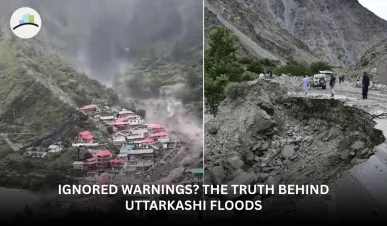
Uttarkashi Floods Reveal Himalayan Crises: Why Dharali Disaster Is a Policy Failure
In early August, a catastrophic flash flood ripped through Dharali village in Uttarkashi, spurred by a massive cloudburst—or potentially a glacial collapse—triggering devastation across hotels, homes, and roads. Despite rescue operations, the broader implications remain unexplored.
Why Did This Happen? A Multilayered Breakdown
This was not merely an act of nature, but a collision between climate stress, faulty infrastructure, and governance failure:
-
Warming Himalayan Climate: Rapid temperature rise in high-altitude zones intensifies monsoon volatility, resulting in sudden downpours of hundreds of millimeters within hours.
-
Glacial Instability: Growing scientific consensus suggests a glacial lake burst or ice collapse may have triggered or magnified the flood—highlighting the risk posed by retreating glaciers.
-
Tourism-Driven Development: Hotels and roads were built dangerously close to unstable slopes and riverbanks, ignoring eco-zone regulations—turning the area into a disaster magnet.
MORE ARTICLES:
What’s Not Being Talked About Enough
1. Economic Rupture Beyond Headlines
Beyond the tragic loss of life, the obliteration of Dharali's hospitality infrastructure threatens the entire valley’s economy. The collapse of tourism and seasonal trade surfaces as a silent crisis—one with little support or insurance.
2. Institutional Vestiges of Risk
While rescue teams responded swiftly, there's no long-term strategy for climate adaptation. Uttarakhand lacks an operational framework for slope audits, real-time alerts, or built-in regional risk zoning.
3. Unseen Security Vulnerability
Reports indicate missing personnel from local army camps near Dharali. Even military outposts built on seemingly safer terrain are not immune—exposing a vulnerability rarely acknowledged.
Why It Matters
This is not an isolated event—it’s the latest wrinkle in a recurring Himalayan pattern: Kedarnath in 2013, Tapovan in 2021, and now Dharali in 2025. As development races uphill without caution, disasters become predictable.
Historical Parallels: The Himalayan Pattern
The 2013 Kedarnath floods and the Tapovan hydropower collapse both stemmed from unchecked development and ignored environmental warnings. Today’s disaster reflects a repetition of past mistakes—despite years of debate, policy inertia persists.
Hidden Risks—or Fresh Opportunities?
-
Climate Insurance for Hill Economies: The Dharali disaster underscores the urgency for micro-insurance products tailored to tourism-linked businesses and high-altitude agriculture.
-
Community-Based Alert Networks: Village-level sensor systems and early-warning communication channels could significantly reduce future casualties.
-
Environmental Enforcement and Restoration: Enforce zoning restrictions, conduct mandatory slope audits, and rehabilitate buffer zones around rivers and glaciers.
-
Glaciological Monitoring: Invest in glacier surveillance and hydrological research to predict high-altitude breaches more accurately.
Conclusion
The Uttarkashi flash flood is a symptom of deeper failures: climate mismanagement, policy inertia, and unchecked development in fragile terrain. Until institutional reforms catch up with climate realities, such tragedies will likely intensify—and repeat.



