
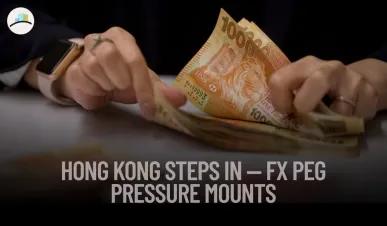
Hong Kong is once again deploying its full monetary arsenal to defend its longstanding currency peg, as the Hong Kong dollar (HKD) nears the strong side of its official trading band. On July 1, 2025, the Hong Kong Monetary Authority (HKMA) stepped in with a direct intervention, purchasing roughly HK$20 billion to counter sustained upward pressure on the currency.
This latest round of action highlights a broader trend unfolding across Asia: pegged and semi-pegged currencies are increasingly being tested as capital flows shift and global rate differentials widen. But in Hong Kong’s case, the commitment to the peg remains unwavering — with the HKMA not only signaling its intent through action, but also tightening liquidity conditions in the process.
More Articles:
Drivers Behind the Renewed Pressure on the Peg
Interest Rate Differentials and the Role of Carry Trades
One of the most significant drivers behind the sustained pressure is the interest rate differential between the United States and Hong Kong. While Hong Kong’s rates (measured by the Hong Kong Interbank Offered Rate, or HIBOR) have risen due to tight domestic liquidity, they remain well above U.S. short-term rates, creating fertile ground for carry trades. Investors borrow in lower-yielding currencies, like the U.S. dollar or Japanese yen, and park their capital in HKD-denominated assets that offer higher yields.
This strategy pushes more funds into the Hong Kong market, leading to appreciation pressure on the local currency. Once the HKD approaches the upper bound of its 7.75–7.85 range, the HKMA intervenes to maintain the currency within its peg.
Capital Inflows Driven by IPOs and Corporate Activity
Another structural pressure point is the surge in capital inflows related to public offerings and dividend conversions by Chinese and regional firms. As companies raise capital in USD but need to operate or distribute in HKD, there is a natural conversion pressure that strengthens the Hong Kong dollar. This adds to the upside bias and tests the currency band repeatedly.
Global Dollar Weakness as a Macro Tailwind
The third major factor is external: the U.S. dollar has been softening against most major Asian currencies as the Federal Reserve maintains a cautious monetary policy stance amid easing inflation. This creates broad-based dollar weakness, lifting regional currencies. For Hong Kong, where the currency is tied directly to the USD, the result is recurring pressure toward the stronger end of the peg.
How the HKMA Manages Peg Defence Without Traditional Rate Hikes
Unlike central banks that use policy interest rates to manage currency and credit conditions, the HKMA relies on automatic mechanisms embedded in its currency board system. When the HKD hits the edge of its trading band, the HKMA intervenes by selling U.S. dollars and buying Hong Kong dollars. This drains liquidity from the local banking system, leading to a tighter credit environment and higher interbank lending rates.
This system is designed to deter speculative attacks and self-correct excess liquidity. As the Aggregate Balance — the amount of settlement funds commercial banks hold with the HKMA — falls, funding conditions in the domestic market tighten, increasing HIBOR and discouraging carry trades.
Over time, these liquidity withdrawals effectively simulate monetary tightening, even though the HKMA does not change policy rates itself. This passive tightening has a direct impact on mortgage lending, corporate credit, and investment flows.
Market Implications of HKMA’s FX Operations
Impact on the Property Sector
Tighter liquidity conditions are likely to cool mortgage lending. In Hong Kong, where home prices are tightly correlated with borrowing costs and credit access, even marginal increases in HIBOR can ripple through the housing market. As the HKMA continues its FX operations, potential homebuyers may face reduced financing capacity, softening demand in what remains one of the world’s most expensive property markets.
Bank Profitability and Credit Risk
For banks, higher interbank rates can widen net interest margins, benefiting profitability. However, the tightening of liquidity also raises credit risk as businesses and households face higher borrowing costs. Smaller enterprises reliant on short-term financing could experience funding stress if liquidity remains constrained.
Cooling the Carry Trade and Foreign Investor Sentiment
By nudging HIBOR higher through liquidity drainage, the HKMA is also sending a strong signal to global investors: the currency peg is not just symbolic—it is actively enforced. This disincentivizes speculative carry trades and restores balance in capital flows. However, this might also reduce short-term attractiveness for international investors seeking arbitrage opportunities in Hong Kong’s bond and equity markets.
Key Insights That Go Beyond Conventional Financial Coverage
Institutional Strength as a Deterrent to Speculation
Unlike many emerging market pegs that have collapsed under capital flight, Hong Kong’s peg is underpinned by a strict currency board system, with full foreign reserve backing. The HKMA operates under clear rules, intervenes transparently, and maintains one of the largest FX reserve war chests in the world. This structural resilience makes speculative attacks far less viable than they might appear at first glance.
Monetary Tightening by Proxy
What is noteworthy in the current context is that the HKMA is effectively tightening monetary conditions without raising policy rates — a distinction that sets Hong Kong apart from many Western economies where rate policy is the primary tool. This "tightening by proxy" affects the broader economy, influences investor behavior, and may be a more globally relevant case study than it appears.
Peg Defence as a Regional Bellwether
As the U.S. dollar weakens and rate differentials narrow across Asia, other currencies with soft pegs or quasi-fixed regimes may come under similar pressures. Hong Kong’s experience, therefore, acts as a bellwether for how FX regimes are evolving in a post-tightening world. Watching the HKMA’s actions could provide early clues about regional monetary shifts in places like Singapore, Malaysia, and Taiwan.
HKMA Intervenes to Protect the Hong Kong Dollar, No Talk of a Peg Break https://t.co/4dpjd93znY
— Exchange Rates UK (@exchangeratesuk) July 2, 2025
Strategic Takeaway for Investors and Policymakers
The HKMA’s defense of the peg is not just a reactive move to short-term currency movements — it is a calculated, rule-based process that shapes liquidity, borrowing costs, and macroeconomic stability. While the peg continues to hold, it is clear that Hong Kong is experiencing a subtle form of monetary tightening. For investors, this has implications for credit exposure, real estate allocations, and hedging strategies in the region.
More broadly, this phase of currency defence marks a turning point in global capital flows, where passive policy mechanisms — not central bank rhetoric — are reshaping risk premiums and asset allocation.
Disclaimer:
This article is intended for informational purposes only and does not constitute investment advice. Procapitas does not provide personalized financial recommendations. Always consult a licensed financial advisor before making investment decisions. Information is based on publicly available sources as of June 2025 and Procapitas’ independent research and analysis.



