
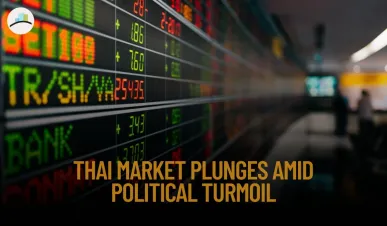
Thailand's fragile political landscape has once again become the focal point of investor anxiety. On July 1, 2025, the Constitutional Court of Thailand suspended Prime Minister Paetongtarn Shinawatra following allegations of breaching official ethics. The suspension was triggered by a leaked phone call involving the Cambodian Prime Minister, raising questions about improper diplomatic conduct.
This move comes just weeks after the Bhumjaithai Party—a key coalition partner—withdrew its support from the ruling alliance, stripping the government of its parliamentary majority. These twin developments have sparked widespread street protests, parliamentary gridlock, and investor panic. The growing political vacuum is undermining the country’s economic momentum and delaying critical decisions in fiscal and trade policy.
More Articles:
SET Index Sinks to Five-Year Low as Foreign Capital Flees
The Stock Exchange of Thailand (SET) has now recorded the steepest losses among major global indices in 2025, down nearly 24% year-to-date. This places Thailand’s equity market as the worst performer globally, surpassing losses seen in other politically unstable economies.
Foreign institutional investors have offloaded over US $4 billion in equities so far this year, marking a sharp reversal from net inflows in 2023. This retreat reflects not only domestic political turbulence but also a broader reassessment of emerging market risk, particularly in Southeast Asia.
The confidence drain is evident across sectors. Real estate, financial services, and tourism-linked equities have seen double-digit declines. Companies tied to domestic consumption and government infrastructure projects have also fallen, caught in the crosshairs of delayed fiscal planning and consumer pessimism.
Global Headwinds Compound Domestic Political Stress
While domestic issues dominate headlines, Thailand’s vulnerability to global shocks is exacerbating the downturn. The U.S. has reimposed tariffs on certain Asian exports, placing Thai manufacturing and logistics in a tough spot. Meanwhile, elevated oil prices due to renewed conflict in the Middle East are inflating energy costs in this import-dependent economy.
Adding to the complexity, Thailand remains tightly linked to China’s supply chain and tourist flows. With China’s post-pandemic recovery faltering and Beijing tightening outbound tourism policies, Thailand’s tourism-dependent GDP segments are facing a twin blow: weak external demand and internal policy paralysis.
These global linkages, once engines of growth, have become stress points for the Thai economy. Without firm leadership at the national level, Thailand is struggling to respond proactively to these external challenges.
Budget Uncertainty and Infrastructure Paralysis Loom
The FY2026 national budget, crucial for infrastructure investment and public sector wage payments, is now stalled. Political uncertainty has frozen parliamentary debate, putting in limbo over $90 billion in proposed spending. The Eastern Economic Corridor (EEC) project—Thailand’s flagship industrial corridor aimed at high-tech manufacturing and logistics—has been directly impacted.
Delayed disbursements are already affecting public-private partnership (PPP) projects, creating a domino effect on employment, supply chains, and domestic investor confidence. With interest rates at a two-decade high and inflation still elevated, any slowdown in public spending further increases the risk of recession.
The paralysis is also beginning to affect Thailand’s credit outlook. Rating agencies have flagged the risk of fiscal slippage and political instability as downside factors in upcoming sovereign reviews. If ratings are downgraded, Thailand could face increased borrowing costs at a time it most needs to stimulate growth.
Sector Rotation Shows Where the Smart Money Is Going
Despite the sharp decline in the broader SET Index, certain sectors have shown resilience. Domestic retail names, such as major convenience store operators and consumer electronics chains, have held up better than the rest of the market. Financial stocks, especially large-cap banks with low non-performing asset exposure, have attracted defensive capital.
Investors are rotating away from tourism, construction, and energy into consumer staples and cash-heavy dividend-paying stocks. This trend suggests that while the political climate remains hostile, sophisticated investors are selectively reallocating rather than fully exiting the market.
Hedge funds and family offices across Singapore and Hong Kong have been reportedly eyeing distressed Thai assets at discounted valuations—particularly in infrastructure and healthcare. This implies a potential floor to the market, albeit one defined more by speculative entry than long-term confidence.
Prime Minister Paetongtarn Shinawatra’s suspension from office has eased near-term political risks for Thailand, but investors remain wary about the country’s prospects and market outlook https://t.co/nFYVUdQ4jC
— Catherine Ngai (@catkngai) July 2, 2025
Long-Term Outlook Depends on Political Resolution and Reforms
While the short-term picture remains clouded, Thailand still holds long-term structural appeal. It has one of the region’s youngest workforces, a strategic geographic location for supply chain diversification, and a high-potential digital economy.
However, realizing this potential depends entirely on resolving the current political impasse and delivering on delayed reforms. This includes judicial reform, public sector transparency, trade diversification, and enhanced social spending—all of which have been stalled by the leadership crisis.
If Thailand can emerge from this political storm with a stable coalition and a reform-minded economic agenda, it has the foundations to recover and reclaim its status as a regional outperformer. Until then, volatility will define its financial markets.
Disclaimer:
This article is intended for informational purposes only and does not constitute investment advice. Procapitas does not provide personalized financial recommendations. Always consult a licensed financial advisor before making investment decisions. Information is based on publicly available sources as of June 2025 and Procapitas’ independent research and analysis.



