
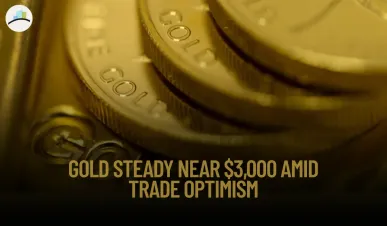
Gold prices stabilized near recent highs this week, with the spot rate hovering just below $3,000 per ounce. The yellow metal, often seen as a barometer for market fear, is showing signs of cooling as improving trade relations between the United States and European Union ease short-term investor concerns and diminish safe-haven demand.
Although gold has surged in 2024 amid global economic uncertainty, its latest performance reflects a cautious pause. Investors are now recalibrating expectations based on strengthening Western diplomatic ties and the outlook for U.S. monetary policy.
Gold’s Pullback Tied to Easing Geopolitical Anxiety
Historically, gold has thrived during periods of financial instability or geopolitical tension. Its value as a hedge against uncertainty has made it a consistent refuge during market downturns or global shocks.
However, recent signs of warming relations between the EU and the U.S. have softened the global risk environment. With new trade agreements under discussion and improved transatlantic cooperation, investors appear more willing to re-enter equity markets, dialing down their appetite for gold—at least temporarily.
This softening demand has caused prices to plateau, preventing the metal from reclaiming recent record-breaking highs.
Gold ETFs Reflect Market Caution
Several prominent gold-backed exchange-traded funds (ETFs) posted marginal gains in recent sessions, suggesting that while interest hasn’t vanished, speculative enthusiasm is currently subdued:
-
SPDR Gold Shares (GLD) closed at $309.75, up a modest 0.02%.
-
iShares Gold Trust (IAU) ended at $63.38, also rising 0.02%.
-
VanEck Gold Miners ETF (GDX) climbed to $50.53, up 0.03%.
-
VanEck Junior Gold Miners ETF (GDXJ) closed at $64.67, gaining 0.03%.
-
SPDR Gold MiniShares Trust (GLDM) settled at $66.57, up 0.02%.
These limited gains highlight a cautious investor sentiment, as markets await stronger cues from macroeconomic indicators or central bank decisions before taking bold positions in gold or gold-related assets.
Focus Shifts to U.S. Inflation and Retail Data
The next decisive movement in gold prices could come from upcoming U.S. economic reports, particularly retail sales, consumer inflation (CPI), and core PCE (Personal Consumption Expenditures) data. These figures will influence market expectations for the Federal Reserve's interest rate path.
A stronger-than-expected economic performance could heighten the possibility of further rate hikes—usually a bearish signal for gold, which pays no interest or yield. Conversely, signs of economic slowdown could reinforce gold's appeal as a defensive asset, potentially reigniting demand.
Long-Term Support from Central Bank Buying
Despite short-term fluctuations, gold remains underpinned by central bank buying, particularly in emerging markets seeking to reduce their reliance on the U.S. dollar. These structural trends help create a safety net for gold prices, preventing significant downside movement even in calmer market conditions.
Analysts continue to view the current pullback as a consolidation phase rather than a long-term reversal. Many believe gold still has room to climb, especially if inflation remains sticky or new geopolitical risks emerge.
Conclusion: Calm Before the Next Move?
With global equities recovering and diplomatic tensions easing, gold is facing a moment of pause. While the metal may not be rallying, it continues to hold value near its recent highs, reflecting investors’ underlying caution.
For now, traders and institutional investors remain in a “wait-and-see” mode. But given gold’s role as a safe-haven asset, any uptick in inflation, global conflict, or monetary policy surprise could quickly shift sentiment and drive the next leg upward.
Disclaimer
This article is for informational purposes only. It does not constitute investment, financial, or legal advice. Investors should perform their own due diligence or consult with a financial advisor before making decisions based on market developments.
Source
Original reporting from Yahoo Finance: https://finance.yahoo.com/news/gold-holds-decline-eu-us-001041189.html
More Articles:



