
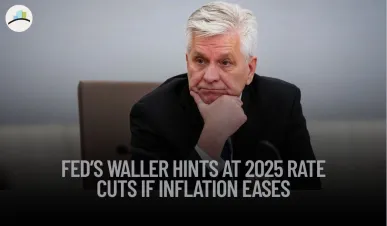
Fed's Waller Indicates Possible Rate Cuts in 2025
Federal Reserve Governor Christopher Waller has expressed openness to the possibility of reducing interest rates later this year, contingent on the trajectory of inflation and the health of the labor market. Speaking in Seoul, Waller emphasized that while recent inflationary pressures, partly due to import tariffs, have been temporary, they should not impede the Fed's policy adjustments. He noted that if core inflation moves toward the Fed's 2% target and the labor market remains robust, he would support rate cuts. Waller also highlighted that the current economic conditions provide the Fed with the flexibility to assess the evolving trade landscape before making policy changes.
More Articles:
Key Factors Influencing Potential Rate Cuts
-
Inflation Trends: Waller anticipates that the inflationary effects from tariffs will be short-lived and not significantly impact long-term price stability. He believes that inflation will continue to progress toward the 2% goal over the medium term, making further rate reductions appropriate.
-
Labor Market Conditions: The strength of the labor market is a critical factor in the Fed's decision-making process. Waller has indicated that as long as employment data remains favorable, the Fed has room to implement rate cuts without risking economic instability.
-
Economic Growth: While some Fed officials have adopted a cautious stance due to policy uncertainty and inflation risks, Waller remains open to reducing rates, provided there is continued progress toward the inflation target and no significant deterioration in the labor market.
🇺🇸 Fed's Waller Open to Interest Rate Cuts Later This Year
— RRN News (@RRNupdates) June 2, 2025
Federal Reserve Governor Christopher Waller stated that interest rate cuts remain possible later in 2025, despite current economic conditions. pic.twitter.com/2ImAxu7yFO
Implications for Investors and Markets
The prospect of interest rate cuts could have significant implications for various sectors:
-
Equities: Lower interest rates may reduce borrowing costs for companies, potentially boosting corporate profits and stock market performance.
-
Bonds: Rate cuts could lead to higher bond prices as existing bonds with higher yields become more attractive to investors.
-
Currency Markets: A reduction in interest rates may weaken the U.S. dollar, affecting international trade and investment flows.
Disclaimer
This article is based on information available as of June 2, 2025. The views expressed are for informational purposes only and do not constitute investment advice. Readers should conduct their own research or consult with a financial advisor before making investment decisions.



