
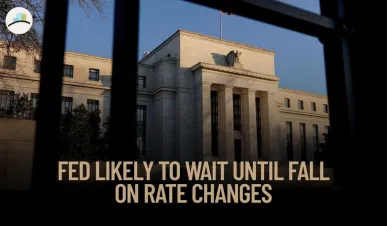
Economists and market watchers are increasingly convinced that the U.S. Federal Reserve will likely hold off on adjusting interest rates until at least September, as policymakers face conflicting economic signals. While inflation appears to be softening, persistent uncertainty from ongoing trade policies and a rising federal deficit are complicating the path forward.
More Articles:
Why the Fed Is Waiting
The Fed has maintained its benchmark interest rate between 4.25% and 4.50%, with no immediate changes expected. This “wait-and-see” strategy reflects caution over macroeconomic risks. The central bank remains wary of taking premature action, especially as the full impact of recently enacted trade tariffs by the Trump administration continues to play out.
Although the inflation rate has moderated—supported by lower prices in categories like fuel, housing, and travel—the broader economic environment remains volatile. New tariffs on Chinese imports and a growing federal deficit could potentially reverse inflation progress and apply fresh pressure on consumer prices.
Diverging Economic Forecasts from Wall Street
Big-name institutions have offered differing projections for the economy and monetary policy. Goldman Sachs has trimmed its recession risk forecast to 30%, expecting growth to remain modest and inflation to stay under control. Their analysts predict the Fed won’t move on rates until December.
Meanwhile, Citi takes a more dovish view, projecting a quicker slowdown in demand that may push unemployment higher and bring inflation lower. Citi expects the Fed to start cutting rates as early as September, continuing that path through 2026.
Oxford Economics has also revised its U.S. growth forecast upward, citing signs of greater resilience in the economy. In contrast, JPMorgan has lowered its GDP outlook, citing the potential consumer drag from increased tariffs under the U.S.-China trade agreement signed earlier this month.
Currency and Global Market Reactions
The uncertainty around Fed policy and economic conditions has led to noticeable shifts in currency markets. The U.S. dollar recently touched a three-year low against a global basket of currencies, as investors respond to soft inflation data and safe-haven positioning by European pension funds.
With the dollar weakening, other global markets are adjusting accordingly. Equity markets have seen uneven performance, while interest in traditionally secure assets like gold and the Japanese yen has risen. Analysts are closely monitoring how global trade relationships and the Fed’s cautious stance will impact longer-term investment strategies.
What Comes Next
🚨Fed Chair Jerome Powell holds interest rates steady at 4.25%-4.5%, defying President Trump's push for cuts. Citing tariff-driven inflation risks and economic uncertainty, Powell emphasizes Fed independence. No rate changes are expected before the June 2025 meeting. pic.twitter.com/Mexfy9C8xj
— 𝐃𝐔𝐓𝐂𝐇 (@pr0ud_americans) May 7, 2025
All eyes are on the Fed’s next policy meeting. While no rate changes are anticipated, the central bank’s updated economic projections and Chair Jerome Powell’s commentary are expected to provide key insights into how the Fed is balancing inflation control with economic growth.
Given the mixed signals, the Fed is expected to remain patient—holding off on any policy shifts until clearer trends emerge later this summer or into early fall.
Disclaimer
This article is published for informational purposes only and does not constitute financial or investment advice. All economic data and forecasts are based on public reports as of the publication date. Readers are advised to consult a financial professional before making any investment decisions.
Source:
Bloomberg - No Clarity for Fed Until at Least September, Economists Say



