
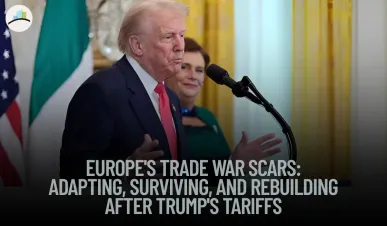
Europe's Trade Tango: Dodging the Trump Tariff Bullet
Honestly, the fallout from Trump’s tariffs on European goods was a wild ride. It wasn't just about higher prices; it forced a serious rethink of how European businesses operate globally. I remember reading the initial announcements, and my first thought was, “Whoa, this is going to be messy.” And it was. It wasn't a clean cut, you know? There were winners and losers, companies scrambling to adapt, and governments trying to figure out how to protect their industries. It really highlighted the interconnected nature of the global economy in a way that was hard to ignore. Suddenly, everyone was paying much closer attention to the intricacies of international trade, whether they wanted to or not. The uncertainty was probably the most unsettling part – companies were hesitant to make long-term plans, investments were put on hold, and the whole thing created this atmosphere of nervousness across the board.
Shifting Sands: How European Businesses Adapted
Many European companies, especially those heavily reliant on exporting to the US, had to get creative. Some diversified their markets, actively seeking new customers in Asia or other regions less affected by the tariffs. Others focused on increased efficiency and streamlining their operations to offset the higher costs. It was impressive to see the resourcefulness – some even invested in research and development to create more competitive products, hoping to build up a brand loyalty that could weather any trade war. But it wasn't easy. Smaller businesses, in particular, struggled to absorb the additional costs, and sadly, some did end up going out of business. The pressure was immense. You had established companies trying to protect their market share, all while dealing with the unpredictability of the political landscape. The entire thing felt like a high-stakes game of chess, with businesses trying to anticipate and outmaneuver the ever-changing rules of the game. I spoke to a few CEOs who described it as a massive undertaking, akin to completely restructuring their entire business model, all in a fairly short time frame.
Government Responses: A Patchwork of Solutions
European governments also had to react. Some offered direct financial support to affected businesses through subsidies or tax breaks. Others focused on strengthening their trade relationships with other countries, aiming to create new markets and reduce dependence on the US. The response wasn't uniform across the continent, though. Each country tackled the problem in a way it felt best suited its particular economic makeup and political priorities. That in itself created some additional complications; for example, competition between European nations emerged as they all fought for access to the same alternative markets. Ultimately, it showcased the significant difficulty of coordinating a coherent response on a continental scale. It also highlighted the fragility of economic agreements, which can be heavily swayed by unilateral decisions made in another country — a sobering experience for many.
Lessons Learned: A More Resilient Europe?
Looking back, the Trump tariffs served as a wake-up call for Europe. It demonstrated the need for greater economic diversification, strategic trade partnerships, and more robust mechanisms to protect domestic industries from external shocks. The experience also forced a clearer understanding of the importance of international cooperation and the need to collectively address global trade imbalances. While the immediate crisis may have passed, the long-term impact is still being felt. We can see, however, that Europe has become more aware of its vulnerabilities and is working towards building more resilience into its economic system. Whether this translates into a genuinely stronger and more unified European economy in the long run remains to be seen, but what is certain is that the period left an indelible mark on the continent's economic and political landscape.
More Articles:



