
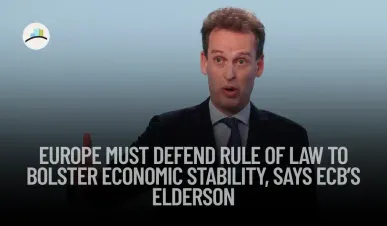
In a significant address delivered on June 9, 2025, Frank Elderson, Executive Board Member of the European Central Bank (ECB), stressed that the European Union’s long-term economic performance depends heavily on the defense and strengthening of the rule of law across member states. Speaking at Italy’s Constitutional Court in Rome, Elderson warned that without judicial independence and institutional integrity, Europe risks undermining investor trust, weakening capital markets, and diminishing the global role of the euro.
Rule of Law: A Pillar of Economic Health
Elderson described the rule of law as more than a legal ideal—it is a foundational pillar of economic functionality. He argued that fair, independent, and transparent legal systems build investor confidence and attract foreign capital, both of which are essential for robust economic growth.
“Europe’s reputation as a beacon of legal certainty, strong institutions, and the protection of fundamental rights is not just morally important—it is economically indispensable,” Elderson said.
The ECB official highlighted that when market participants perceive legal ambiguity or politically influenced judicial systems, it increases perceived investment risk, raising borrowing costs and dampening cross-border capital flows.
Context: EU’s Ongoing Governance Challenges
Elderson’s remarks come at a time when multiple EU member states have faced criticism for undermining judicial independence. Countries like Poland and Hungary have been at the center of rule-of-law investigations by the European Commission, with accusations including politically motivated judicial appointments, media repression, and attacks on minority rights.
Also Read:
These governance issues have not only drawn international criticism but have also impacted financial instruments like EU recovery funds. Brussels has withheld billions in funding over concerns about the misuse of power and backsliding on democratic norms.
The ECB's growing concern with governance reflects a broader realization: legal instability can have macroeconomic consequences. For instance, sovereign bond yields in legally vulnerable nations often spike in times of political uncertainty, as investors price in added risk.
Market Implications and ECB’s Role
Elderson hinted that the ECB is increasingly factoring legal risk into its financial models and policy frameworks. Analysts interpret this as a signal that the central bank could, in the future, condition its bond-buying and liquidity tools on governance benchmarks—although no formal policy has been announced.
He also pointed out that the ECB, as a steward of financial stability, cannot ignore the institutional factors that impact financial markets.
“Governance quality, like inflation expectations or employment data, is a key input into our broader economic assessments,” Elderson noted.
If legal instability continues to rise within parts of the eurozone, the ECB could incorporate this into stress-testing scenarios for banks or adjust how it treats sovereign debt in its portfolios.
Legal Certainty Strengthens the Euro
Beyond short-term financial metrics, Elderson emphasized that legal clarity is fundamental to the euro's international standing. In a world of competing currencies, geopolitical uncertainties, and growing digital assets, the euro must offer not only monetary strength but institutional reliability.
He warned that if legal standards deteriorate, confidence in the eurozone's long-term viability could weaken, potentially eroding the euro's reserve currency status over time.
Source
Bloomberg – Europe Must Defend Rule of Law Standards, ECB’s Elderson Says



