
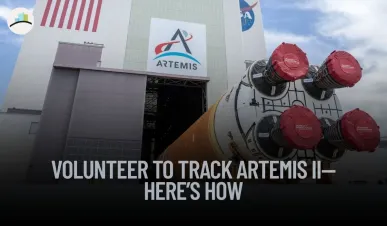
NASA is reaching out to the public with an unprecedented invitation: help track the Artemis II mission, the first crewed flight in the Artemis lunar exploration program. This call to citizen scientists and space enthusiasts worldwide raises a compelling question—why is NASA opening one of its most critical space missions to volunteers? What does this mean for the future of space exploration and the role of the public in high-stakes missions?
Why Is NASA Inviting Volunteers to Track Artemis II?
Historically, spacecraft tracking has been managed exclusively by government agencies equipped with highly specialized technology. So, why is NASA turning to the public and commercial partners to track Artemis II, a mission that will carry astronauts beyond low Earth orbit for the first time in decades?
NASA is embracing a new collaborative model that combines official tracking systems with crowdsourced data collected by volunteers equipped with ground-based radio antennas. This strategy grew from the successful Artemis I mission, where volunteers worldwide tracked the uncrewed Orion spacecraft, providing valuable supplementary data.
But Artemis II raises the stakes—this is a crewed mission involving real astronauts. Can NASA’s expanded, decentralized tracking network maintain the rigorous standards of precision and reliability required to safeguard human lives? What measures are in place to validate volunteer data and ensure it complements official systems?
MORE ARTICLES:
What Makes Artemis II a Pivotal Mission?
Set to launch no later than April 2026, Artemis II will send four astronauts—three from NASA and one from the Canadian Space Agency—on a 10-day journey around the Moon aboard the Orion spacecraft. This mission isn’t just a routine test flight; it’s a critical demonstration of several cutting-edge technologies, including NASA’s Space Launch System (SLS) rocket and the life-support and navigation systems aboard Orion.
Successfully completing Artemis II will pave the way for Artemis III, the mission planned to land astronauts on the lunar surface, and will serve as a springboard for even more ambitious goals—sending humans to Mars.
Given this significance, NASA’s decision to incorporate volunteer tracking sparks important questions: How will this influence mission safety? Could the public’s involvement in such a high-profile mission inspire greater interest and investment in space exploration?
How Can You Participate, and What Will You Gain?
NASA is inviting volunteers—ranging from amateur radio enthusiasts to professional ground station operators—to track the Orion spacecraft by capturing radio signals during its mission. Volunteers will use their own ground-based equipment to monitor these signals, providing real-time data that supplements NASA’s primary tracking networks.
For participants, this is a unique chance to be directly involved in a historic space mission. Beyond the excitement of contributing to human spaceflight, volunteering also offers opportunities for educational engagement, fostering a deeper appreciation for STEM fields and inspiring the next generation of explorers.
Could this model of public involvement become a blueprint for future space missions, expanding citizen science in ways previously unimagined?
Australia’s First #Lunar Rover ‘Roo-ver’ Confirmed for @NASA #Artemis Mission, in @Aus_in_Space https://t.co/YA4I34dDYO #Lunapolitics #Australia
— Lunapolitics (@PoliticsLuna) August 29, 2025
What Does This Mean for NASA’s Broader Vision?
NASA’s initiative to blend public, commercial, and governmental tracking capabilities reflects a strategic shift towards a more inclusive and sustainable space program. Leveraging a wider network helps NASA reduce costs, increase data redundancy, and foster innovation through collaboration.
This new approach aligns with NASA’s long-term goals of establishing a permanent human presence on the Moon and preparing for crewed missions to Mars. It also positions NASA as a pioneer in the emerging space economy, encouraging private sector growth and public participation.
Yet, this raises further questions: Will this hybrid tracking system set a new standard for mission safety and efficiency? Could similar collaborative models accelerate advancements in space technology and exploration?



