
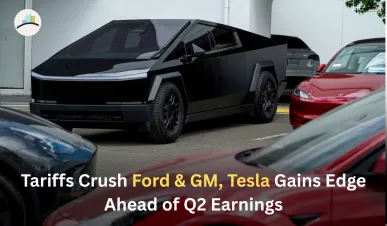
U.S. automakers are walking into a stormy Q2 earnings season, not from weak demand, but from heavy-duty policy headwinds. Ford and GM are bracing for a multi-billion-dollar drag from Trump's 25% tariff on imported vehicles. Meanwhile, Tesla may emerge the short-term winner—though long-term challenges loom.
1. Why It’s Happening
President Trump’s trade strategy is now in action: starting this year, 25% tariffs on vehicles and parts have kicked in, even as adjustments offer partial relief—like a 15% first-year offset on certain domestic components. Ford forecasts a $2.5 billion cost hit and a $1.5 billion profit drop, while GM anticipates $4.5–5 billion in tariff costs, slashing its earnings outlook
Tesla and Rivian—producing entirely in the U.S.—are insulated from vehicle-level levies. Tesla stands out as the most shielded from these trade shocks
2. What’s Being Underplayed
A. Dealer Buffering & Demand Timing
Despite tariff pressure, new vehicle sales actually rose ~3% in H1, as buyers rushed to purchase before price hikes . But retailers are now holding inventory—amplifying pressure on automakers to ride out a likely slowdown in later quarters.
B. EV Tax Credit Loss
Tesla is about to lose the $7,500 EV tax credit on Sept. 30—a critical boost for U.S. sales .The auto sector’s reliance on policy incentives adds another layer of volatility, not often discussed alongside tariffs.
C. Foreign OEM Effects
German and Japanese automakers face $6,000–12,000 per unit tariff impacts, far higher than U.S. counterparts—a near death blow for luxury brands like BMW and Mercedes. Expect a reshuffle in market share .
3. Economic & Market Implications
| Stakeholder | Immediate Impact | Medium-Term Outlook |
|---|---|---|
| Ford & GM | Earnings cut; guidance withdrawn | Investors will watch cost-cutting and localization strategies |
| Tesla & Rivian | Relative earnings stability; valuation tailwind | Faces EV tax credit loss and intensifying EV competition |
| Foreign OEMs | Cost-proliferation threatens US sales | May prompt regional production shifts or price increases |
| Consumers | Price hikes hit, especially on imported brands | May pivot to domestic alternatives or delay purchases |
4. Historical Echo
In the 1980s, Japanese import tariffs sparked a shift in U.S. manufacturing and dealership dynamics. Then, as now, policy shockwaves triggered consolidation and local investment. Today’s tariffs may re-ignite "Buy America" strategies—yet remind us that trade policy can’t prop up domestic production alone.
5. Risks & Return Paths
-
Risk: Sales could slump by 1 million units in 2025, driven by tariff-induced price sensitivity
-
Opportunity: Ford’s ~80% U.S.-built volume may give it resilience—especially if dealers keep stocking domestic SUVs
-
Risk: For Tesla, losing the EV credit could erase much of its automaker advantage—timed alongside its robo‑taxi ambitions
-
Opportunity: Foreign OEMs may accelerate U.S.-based investment or premium pricing strategies to offset tariffs.
Also read on Procapitas
6. What To Watch
-
Earnings tone from Ford and GM—especially their cost mitigation plans.
-
Tesla Q2 guidance: will they signal continuing pricing power or headwinds?
-
Dealer inventory and pricing trends—a lagging but telling market barometer.
-
Policy action: Any new trade deal or exemptions could rapidly shift cost curves.
🔑 Why You Should Care
-
For investors: Auto stocks now hinge less on demand than on policy volatility.
-
For policy watchers: This is a live test of how tariffs affect industrial sectors—bigpayer or boomerang?
-
For consumers: Expect inflated vehicle prices and delayed EV adoption decisions.



