
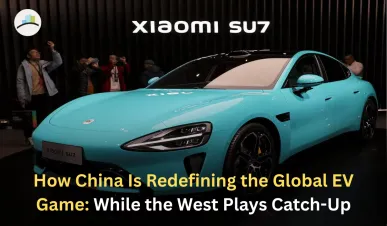
While much of the world debates charging networks and subsidies, China is building electric vehicles (EVs) at a scale and speed that has stunned global competitors. In 2024 alone, China exported over 1.5 million EVs, more than any other country. The nation’s ability to rapidly develop and commercialize electric models isn't just about cheap labor or state support—it’s about structural industrial design, tech centralization, and brutally efficient market coordination.
What makes China's EV ecosystem so fast, and what does it reveal about the future of the auto industry?
🧠 Why Is This Happening: China's Unique EV Acceleration Formula
At the heart of China’s EV success is a vertically integrated, government-coordinated innovation model, which contrasts sharply with the fragmented, legacy-driven systems of Western automakers.
China’s EV Acceleration Stack:
| Factor | China's Advantage |
|---|---|
| Battery Ecosystem | Home to CATL and BYD—world’s top battery makers |
| Central Planning | Industrial policy aligns R&D, infrastructure, and subsidies |
| Manufacturing Speed | Vehicle rollout cycles under 24 months |
| Software & Hardware Integration | In-house operating systems (e.g., Nio, Xpeng) |
| Design-Production Loop | Faster iteration via digital twins, 3D prototyping |
| Price Discipline | Government-supported price wars to kill weak players |
🇨🇳 Key Insight: China doesn't just make cars—it engineers ecosystems. From lithium mines in Africa to charging networks in Tier 3 cities, the entire value chain is controlled or coordinated to compress timelines and eliminate inefficiencies.
💥 The Hidden Risk for Western OEMs: The Speed Gap Is Strategic
China's rapid EV rollout isn't just a business advantage—it’s becoming a geopolitical lever. The EU and U.S. are already investigating Chinese EV subsidies, fearing unfair trade practices. But regulation may be too late.
Consider this:
-
BYD launched 26 models in 2023 alone—more than Ford and GM combined.
-
Average concept-to-showroom timeline in China: ~18–24 months
vs. 36–48 months in the U.S. and Europe.
💣 What’s Not Being Discussed Enough:
The real threat isn't just cheap EVs—it’s China’s ability to set the next generation of automotive software and mobility standards, especially as smart dashboards, autonomous features, and AI assistants become central to the driving experience.
🏭 Economic Implications: From Cars to Platforms
China’s carmakers are morphing into platform companies. With native OS development (like Nio’s Banyan) and integrated infotainment ecosystems, Chinese EVs are bundling mobility, entertainment, and data services—just as Apple bundled hardware and software in smartphones.
| Legacy OEM (e.g. Ford, VW) | Chinese EV Maker (e.g. BYD, Nio) |
|---|---|
| Car as product | Car as platform |
| Vendor-sourced software | In-house software & cloud services |
| Linear supply chain | Full-stack ecosystem control |
| 4-year dev cycles | 12–24 month cycles |
💡 Fresh Angle: China’s EV dominance may end with foreign automakers relegated to commodity suppliers or niche players unless they can match speed, integration, and scale.
Also read on Procapitas -
📉 What the West Risks Ignoring
-
Legacy lock-in: U.S. and EU automakers are still tied to century-old internal combustion infrastructure and dealer models.
-
Subsidy misalignment: Western EV incentives often benefit high-end vehicles, while China targets mass affordability.
-
IP erosion: Chinese brands are setting UI/UX norms and gaining massive user data advantages that fuel next-gen innovation.
“We’re not in a car war—we’re in a systems war. China is exporting industrial design discipline, not just vehicles.”
— Dr. Harish Mehta, Professor of Global Supply Chains, INSEAD
🔮 Final Takeaway: If You’re Still Thinking EVs Are Just Cars, You’ve Already Lost
China’s EV play isn’t just about selling cars faster. It’s about reshaping mobility as a service, dominating battery tech, owning the data layer, and making time a weapon. While the West debates charging infrastructure and tax credits, China is racing through industrial revolutions in real-time.
Unless Western OEMs and governments respond with equal urgency, the next mobility superpower is already decided—and it's not in Detroit, Munich, or Tokyo.



