
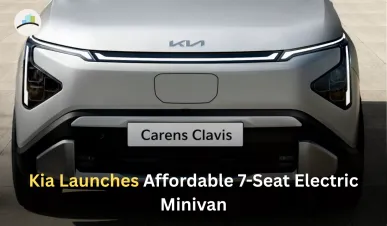
Kia has officially launched its new electric 7-seater minivan, dubbed the Kia KA4 EV in China — a model that blends futuristic styling, functional space, and accessible pricing. But behind the clean-sheet design and family-friendly features is a deeper play: Kia is positioning itself for the next wave of EV adoption in markets where value, not just tech, will win the race.
Starting at just around $30,000 in converted pricing, this model isn’t just another niche electric vehicle. It represents a deliberate shift in the EV arms race, where the focus is finally turning toward family transport, not just tech-savvy singles or luxury buyers.
Why Did Kia Build an Affordable Electric Minivan?
Because no one else is — and because the market is quietly hungry for one.
While the EV landscape has seen an explosion of SUVs, crossovers, and compact sedans, electric minivans remain severely underrepresented. That’s despite the fact that multi-kid households and urban transport operators (like ride-shares or vanpool services) are among the most cost-conscious and space-needy segments — perfect for electrification, if the product exists at the right price.
Most major automakers are still focused on large electric SUVs, pickup trucks, and premium sedans. Kia, on the other hand, is looking at the middle of the market in Asia, where family vehicles remain a high-volume category. This is less about tech flag-waving and more about quietly dominating an overlooked space.
What’s Not Being Discussed Enough?
🔹 The China Strategy Is More Than Just Localization
While this EV minivan is launching first in China, it’s not just about that market — it’s about establishing pricing benchmarks and segment footholds that will ripple outward. With China rapidly saturating the EV space, affordable MPVs (multi-purpose vehicles) could be the next frontier — and Kia wants to be there first.
🔹 It’s a Subtle Rebuttal to Tesla’s High-Price EV Trap
Most mainstream EVs in the U.S. and Europe hover around or above the $40,000–$50,000 mark. Kia’s approach is radically different: go after volume, not margin, and scale aggressively with models that meet basic family needs at combustion-era prices.
🔹 A Minivan Could Be the EV Fleet Workhorse
Beyond families, this minivan could quietly find a second life in last-mile transport, airport shuttles, and fleet logistics, especially if Kia adapts it for modular interiors. In markets like Southeast Asia or Eastern Europe, fleet electrification is growing — but options are lacking. A reliable 7-seat EV with sliding doors and fast charging could change that.
Also read on Procapitas
Economic and Strategic Implications
1. Kia Is Redefining What Entry-Level EVs Can Look Like
Most budget EVs today are small city cars with minimal range and questionable safety. This minivan, with its full-size seating and likely respectable range (expected to be 250–300 miles), challenges the assumption that affordability means sacrifice.
2. It Could Push Other Automakers to Reconsider the Minivan Segment
Automakers like Toyota, Honda, and Ford have deprioritized minivans in favor of SUVs. But if Kia finds success — especially in Asia or Latin America — we could see a reminivanization of the EV market, especially for practical, high-occupancy use cases.
3. Smart Timing for Emerging Market EV Growth
As EV incentives cool in the U.S. and EU, growth is shifting toward Asia, Africa, and South America. This minivan positions Kia as a first mover in the affordable electric family mobility space, with little direct competition outside China’s domestic brands.
Historical Parallel: The Return of the Practical Hero
In many ways, this move mirrors what Toyota did with the Innova and Honda with the Odyssey in the combustion era — build practical, durable, mass-appeal vehicles that dominate roads quietly. Kia is trying to do that for the EV generation — not through flashy features, but through functional reliability at the right price point.
Why This Matters
In the noise of 600-horsepower electric trucks and luxury SUVs, Kia is quietly building the electric minivan that the real world actually needs. It’s a signal that the EV market is finally maturing, moving away from tech showcases and toward genuine everyday utility.
If this model scales, it could reshape what EV adoption looks like in emerging economies, put pressure on pricing across segments, and push more legacy automakers to think beyond performance and prestige — and back to people.



