
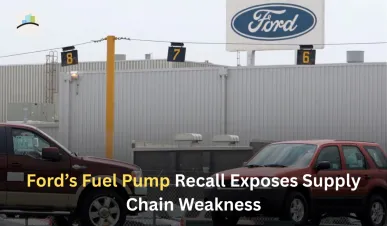
Ford is recalling nearly 775,000 vehicles globally due to defective fuel pump components that could lead to engine stalling — a problem tied to fuel delivery modules supplied by Denso, one of the world’s largest automotive parts makers. Affected models include several high-volume nameplates such as the Ford Explorer, Maverick, F-150, and Bronco Sport, spanning the 2021–2022 production years.
While this appears to be a conventional safety recall, it’s emblematic of a deeper, less visible challenge: supply chain standardization gone too far. As automakers increasingly rely on a small set of global suppliers for core components, a single faulty part — even one as mundane as a fuel pump impeller — can cascade into a multi-brand, multi-million vehicle liability.
What Happened?
The National Highway Traffic Safety Administration (NHTSA) bulletin cites fuel pump impellers that can deform or swell, especially under high-temperature conditions or ethanol-blended fuels. This can cause the pump to seize and stop fuel flow, leading to sudden engine stalls while driving — a serious safety risk.
Though no deaths have been reported, the risk of accidents increases significantly if a vehicle stalls in motion. The issue mirrors similar recalls by Toyota, Honda, Subaru, and Mazda in recent years — all involving Denso as the supplier. This pattern points to a systemic problem, not an isolated defect.
What's Not Being Discussed Enough?
🔹 A Single Supplier, Multiple Failures
Denso’s widespread presence in the industry means one faulty batch can trigger recalls across half a dozen automakers. According to IHS Markit, Denso is among the top three suppliers for fuel systems globally. Its components are found in over 25% of global vehicle production, making any quality lapse disproportionately consequential.
🔹 Platform Sharing and the Domino Effect
The affected Ford models span different segments — from compact trucks like the Maverick to large SUVs like the Explorer. This is possible because of platform modularity and parts sharing, which cut costs but amplify risk. If one part goes bad, the fallout isn’t isolated — it ripples across multiple models and markets.
🔹 Recall Fatigue and Brand Trust
Ford has issued multiple recalls over the past 24 months, from rear axle bolts to battery cable failures. While none are catastrophic individually, the cumulative effect erodes consumer trust and resale value — especially in segments like pickups and SUVs where long-term durability is a key selling point.
More Articles:
The Bigger Picture: Regulatory and Economic Implications
1. Liability for Suppliers:
In cases like this, cost-sharing negotiations follow. Ford may seek reimbursement from Denso, but such disputes can take months or years to resolve — especially if the root cause involves gray zones in testing protocols or material specs.
2. Increased Scrutiny from NHTSA:
Given the multi-brand impact, regulators may begin reviewing testing procedures and supplier vetting processes more closely. It could also prompt a wider industry investigation into shared components across OEMs.
3. Supply Chain Localization Pressure:
This also strengthens the case for localizing critical auto part production — a trend already accelerating due to geopolitical tensions and EV policy pressures. Centralized risks from global suppliers are becoming less tolerable as vehicle safety becomes a national interest.
Historical Parallel: Takata, Revisited?
While not nearly as deadly or large in scale, this situation has shades of the Takata airbag crisis — one supplier, multiple automakers, and a defect that played out over years. Takata’s failure led to over 67 million airbags recalled and ultimately bankruptcy. The current fuel pump saga may not reach that scale, but it’s a warning shot about over-consolidation in the parts industry.
Why This Matters
This isn't just about fixing faulty fuel pumps — it's about re-evaluating the structural fragility of today’s vehicle manufacturing ecosystem. As cars become more complex but rely on increasingly standardized parts, one supplier’s mistake can impact millions of consumers, dozens of models, and billions in liabilities.
For Ford, it’s another reputational bruise. For the industry, it’s a call to rethink how “cost-efficient” supply chains can quickly become dangerously brittle.



