
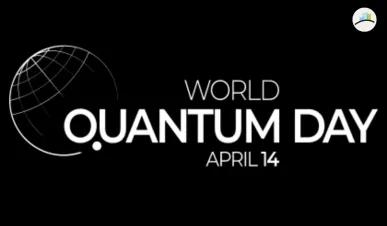
Every year on April 14, scientists, researchers, and technology enthusiasts across the globe celebrate World Quantum Day—a tribute to one of the most fascinating and powerful fields of modern science: Quantum Physics.
The date (4/14) is not random—it directly relates to one of the most important numbers in science: 4.14, the first three digits of Planck's constant. This constant lies at the heart of quantum mechanics and defines how energy behaves at the smallest scales of the universe.
What Does World Quantum Day Mean?
World Quantum Day is more than just a symbolic celebration—it’s a global effort to:
- Spread awareness about quantum science
- Encourage innovation in emerging technologies
- Inspire students and researchers to explore quantum careers
- Showcase breakthroughs in fields like Quantum Computing
Governments, universities, and organizations host seminars, workshops, and public lectures to make complex quantum ideas accessible to everyone.
Why Is It Celebrated on April 14?
The choice of April 14 (4.14) is rooted in Planck’s constant (h ≈ 6.626 × 10⁻³⁴ Js), but the simplified 4.14 × 10⁻¹⁵ eV·s version is often used in quantum physics contexts involving electron volts.
This constant was introduced by Max Planck, whose groundbreaking work in the early 20th century led to the birth of quantum theory.
Othr Stories-
-Vince Gill Turns 69: Celebrating a Country Music Legend’s Enduring Legacy
-David Jones in Crisis: Staff Cuts, Supplier Delays Shock Market
What Is Planck’s Constant?
At its core, Planck’s constant defines the relationship between energy and frequency of a particle or wave.
E=hνE = h \nuE=hν
- E = Energy
- h = Planck’s constant
- ν (nu) = Frequency
This simple equation explains how energy is “quantized”—meaning it exists in discrete packets rather than continuous flows.
👉 Without this concept, modern physics—and technologies like lasers, semiconductors, and quantum computers—would not exist.
The Rise of Quantum Computing
One of the biggest reasons World Quantum Day is gaining momentum is the rapid advancement in quantum computing.
Unlike classical computers, which use bits (0 or 1), quantum computers use qubits, allowing them to process multiple possibilities simultaneously.
Major companies like IBM, Google, and Microsoft are investing heavily in this space.
Why it matters:
- Faster drug discovery
- Advanced financial modeling
- Stronger cybersecurity
- Climate simulations
Why Quantum Science Is in the Spotlight in 2026
The buzz around World Quantum Day 2026 is driven by:
- Breakthroughs in quantum processors
- Growing investments by governments worldwide
- Increasing demand for quantum-skilled professionals
- Integration of quantum tech with AI and data science
India is also stepping up through its National Quantum Mission, aiming to become a global leader in quantum technology.
The Bigger Picture
Quantum science is no longer limited to laboratories—it’s quietly shaping the future of computing, communication, and even national security.
World Quantum Day serves as a reminder that the smallest building blocks of the universe hold the biggest potential for transformation.



