
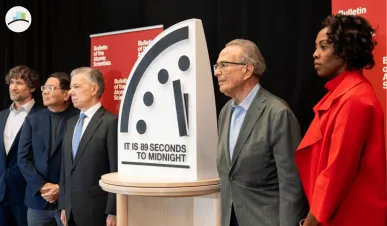
The Doomsday Clock is a countdown to humanity's possible end — a reminder of the global threats that loom large over us. The year 2026 has arrived, and it's more alarming than ever. For over seven decades, atomic scientists have used the clock to represent how close we are to self-destruction. And now, with each tick, the time is dangerously close to midnight. But what exactly does that mean for us, and more importantly, how much time do we have left?
The Clock Ticks Closer to Midnight: But Why?
In 2026, the hands of the Doomsday Clock have shifted ever closer to midnight — a moment of total disaster. Why? Experts are sounding the alarm over a toxic combination of nuclear threats, climate change, and unprecedented global instability. The clock doesn’t just measure time; it measures our survival. And right now, it’s ticking faster than it ever has before.
The reality is chilling: we are living in a time where one misstep could push us past the point of no return. With escalating geopolitical tensions, the race to develop nuclear weapons, and the catastrophic impacts of climate change, the Doomsday Clock is not just a symbol; it’s a call to action. We’re in a race against time, and we might be running out of it.
Atomic Scientists Are Raising Their Loudest Alarm Yet – Here’s Why
Atomic scientists set the "Doomsday Clock" to 85 seconds before midnight, 4 seconds closer than 2025.
— Al Jazeera English (@AJEnglish) January 27, 2026
Scientists cite aggressive behaviour by nuclear powers, the US, Russia, China, wars in Ukraine and the Middle East and AI as factors risking global disaster, reports Reuters. pic.twitter.com/WcIkiCfcY6
Atomic scientists, who manage the Doomsday Clock, have never been more urgent in their warning. The clock's hand has edged closer to midnight because the factors threatening humanity’s survival have multiplied. Here’s what they say is at stake:
-
Nuclear Weapons: With global tensions escalating in regions like Eastern Europe, Asia, and the Middle East, nuclear risks are higher than ever. The possibility of a nuclear war is more real than anyone would like to admit.
-
Climate Crisis: We’ve witnessed catastrophic wildfires, deadly storms, and rising sea levels. Climate change isn’t just a problem for the future — it’s happening now, and the clock is ticking louder because of it.
-
Pandemics and Biological Threats: The COVID-19 pandemic is just one example of how vulnerable we are to biological hazards. But there’s a growing fear that future pandemics might be even more devastating.
These are just a few of the existential threats that are driving the clock closer to midnight. As the clock ticks, the likelihood of these events spiraling out of control increases, and so does the pressure to act.
What Happens When the Clock Strikes Midnight?
The ticking Doomsday Clock isn’t just a metaphor. Midnight represents the end of humanity, where the consequences of our actions — or inaction — have pushed the world past the point of no return. If the clock were to strike midnight today, it would signify an irreversible global catastrophe. But what could that mean for us?
-
Nuclear Fallout: A full-scale nuclear war would decimate the planet, creating widespread radioactive contamination and plunging us into a nuclear winter.
-
Ecological Collapse: If we continue to neglect the environment, the damage could be irreversible. Ecosystems could collapse, leading to mass extinctions and a collapse in food and water supplies.
-
Human Extinction: As climate change and pandemics become more deadly, we face the grim reality that human life as we know it could be unsustainable. Are we already too late to reverse the damage?
MORE ARTICLES:
The Urgent Question: How Much Time Do We Have Left?
As 2026 unfolds, the question on everyone’s mind is: How much time do we have left before the Doomsday Clock strikes midnight?
The answer is unclear, but one thing is certain — we must act now. The decisions we make today will determine the future of humanity. It’s time for governments, corporations, and individuals to come together to address these threats head-on. The time to wait is over.
-
Nuclear Disarmament: If we want to move the hands of the clock back, global efforts to reduce and eventually eliminate nuclear weapons are critical.
-
Climate Action: Immediate, large-scale efforts to curb emissions and transition to sustainable energy sources are essential to buying us more time before the environmental crisis becomes irreversible.
-
Global Cooperation: International diplomacy and conflict resolution are the only way to avoid the catastrophic effects of escalating geopolitical tensions. We need unity.
What Can You Do to Help?
As terrifying as the situation may seem, we still have the power to influence the outcome. The clock isn’t just in the hands of world leaders. It’s in our hands too. Here’s how you can help:
-
Support policies for nuclear disarmament and global peace.
-
Advocate for stronger climate action and a transition to renewable energy.
-
Stay informed about global risks, and demand action from your governments and corporations.
The Doomsday Clock is ticking. But it’s not too late. We can still turn back the hands of time—if we act now.



