
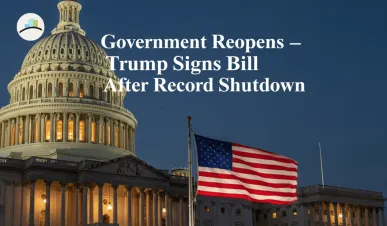
After more than six exhausting weeks of political gridlock, financial uncertainty, and national frustration, the U.S. government is finally open again. President Donald Trump signed the funding bill late Wednesday night, officially ending the 43-day shutdown, the longest in American history.
The move brings long-awaited relief to millions of federal workers and contractors who went without pay for weeks, and to ordinary citizens who felt the ripple effects in everything from air travel to food assistance programs.
What caused the shutdown?
The standoff began when Congress failed to reach an agreement on government funding. The biggest sticking point was whether to include an extension of Affordable Care Act (ACA) subsidies — Democrats wanted them, Republicans didn’t. The impasse dragged on for weeks, paralyzing parts of the federal system and leaving essential services stretched thin.
During those 43 days, hundreds of thousands of federal workers were either furloughed or forced to work without pay. Air traffic delays mounted, national parks closed, and programs like SNAP (food assistance) faced funding gaps. For many families, the shutdown wasn’t just a headline — it was a daily struggle to stay afloat.
MORE ARTICLES:
Trump signs the bill
The breakthrough finally came when both the House and Senate approved a stopgap spending bill on November 12. The House passed it 222-209, following a tense evening session that stretched late into the night.
Hours later, President Trump signed the measure into law, calling it a “Republican victory” and promising that “the government is working again.” His administration also announced that SNAP benefits and federal worker back pay would be restored “within 24 hours.”
Is the shutdown really over?
For now, yes — the bill funds the government through January 30, 2026, giving lawmakers breathing room but not total peace.
Federal agencies are reopening, workers are returning to their desks, and operations that had slowed to a crawl are finally restarting.
However, the relief is temporary. The deal didn’t include the ACA subsidy extension that sparked the original fight, setting the stage for another funding battle early next year.
The toll on Americans
Beyond the politics, this shutdown has left real scars.
-
Families of federal workers missed mortgage payments.
-
Travelers faced flight delays and safety concerns as TSA staffing dropped.
-
Food banks saw surging demand as SNAP disruptions hit vulnerable households.
-
Small businesses that rely on government contracts lost weeks of revenue.
Economists estimate that the shutdown cost the U.S. billions of dollars and dented overall economic confidence. Even with operations resuming, it could take months for agencies to recover from the backlog.
What happens next?
For now, Washington has hit the reset button. But the calm may not last long. With another funding deadline looming in January, lawmakers must negotiate again — this time, hopefully, without taking the country to the brink.
As President Trump framed it, “This is a win for the American people.”
But for those who went weeks without a paycheck or worried whether they could buy groceries, it felt less like a win — and more like the end of a long, unnecessary ordeal.



