
Storm Chasers Watched Twin Tornadoes Touch Down Simultaneously in Oklahoma Here Is What Happened on the Ground
As a four-day severe weather outbreak began across Oklahoma on Thursday 23 April 2026, footage captured by storm chasers showed two tornadoes forming side by side — a rare meteorological event that scientists call a "satellite tornado" or twin vortex.
Storm chasers racing across central Oklahoma on Thursday captured what meteorologists describe as one of the rarer sights in tornado science: two tornadoes on the ground at the same time, rotating in close proximity during the opening hours of what forecasters warned would be a multi-day severe weather outbreak.
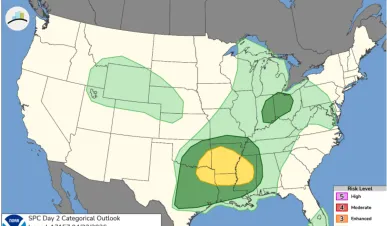
The Storm Prediction Center issued an Enhanced risk Level 3 of 5 for the region on Thursday 23 April 2026, valid through the afternoon and evening hours, with conditions favourable for supercell development across northern Oklahoma and into southern Minnesota.
What Storm Chasers Saw
The twin tornado event was captured on video by multiple storm chaser teams operating in the field and shared widely on social media. Meteorologists watching the footage noted the visual characteristics of a satellite tornado a smaller vortex that forms and orbits around a larger, primary tornado, both sharing the same parent supercell thunderstorm.
According to extreme meteorologist Reed Timmer, storms on Thursday developed along a dryline that extended from northern Oklahoma into the Midwest, creating the instability needed for multiple simultaneous vortices to form within a single supercell. A dryline the boundary between dry desert air from the west and moist Gulf air from the south is one of the primary triggers for supercell formation across Tornado Alley.
Satellite tornadoes are distinct from the more commonly photographed multi-vortex tornadoes, in which several smaller suction vortices rotate around the interior of a single funnel. In a satellite event, the secondary tornado maintains a separate, visible funnel and can travel independently before merging with or dissipating near the primary storm.
A Season Already on Record Pace
Thursday's twin tornado event did not occur in isolation. According to the National Weather Service, Oklahoma recorded 22 tornadoes in March 2026 alone a new state record for the month. By mid-April, the state had recorded a further 11 tornadoes, bringing the 2026 total to 38 confirmed touchdowns before the four-day outbreak had even begun.
Although that pace may feel extreme to residents, it remains below the state's April record of 56 tornadoes set in 2024.
Nationally, preliminary Storm Prediction Center data showed 274 tornado reports across the United States in the first three months of 2026 alone 23 in January, 55 in February, and 196 in March.
Oklahoma averages approximately 62 tornadoes per year, more per square mile than any other state in the nation.
Other Stories-
-Asiago News 2026: The Inspiring Story Behind Italy’s Local Business Honors
-Pantheon Entry Fee 2026: What Travelers Must Know Before Visiting Rome
-James Valentine Dead at 64: ABC Radio Star Dies After Cancer Battle
The Four-Day Outbreak Ahead
Thursday's tornado activity marks only the beginning of a four-day severe weather window running through Sunday 26 April. According to forecasters, a majority of Oklahoma will be affected on Friday, Saturday, and Sunday, with areas along and east of Interstate 44 facing the greatest risk. All modes of severe weather are expected across those four days — including large hail, damaging wind gusts, and tornadoes.
Oklahoma residents have been encouraged to monitor the forecast closely as details will continue to change, and to be prepared for the possibility of power and water outages lasting days to weeks.
A Warning System Under Pressure
The twin tornado footage also arrives in the context of a wider institutional concern. Following the March 2026 tornado outbreak, Michigan Governor Gretchen Whitmer's office called for a probe into the absence of a tornado watch alert during that event, questioning whether it could be attributed to President Donald Trump's funding cutbacks to the National Weather Service. Federal weather officials acknowledged that the storm had been concentrated in a small three-county area, making advance detection more difficult.
The National Weather Service offices at Norman, Tulsa, and Amarillo cover all of Oklahoma's distinct weather zones. As of publication, no statement has been issued by NWS Norman regarding the twin tornado event or any formal rating of Thursday's touchdowns.
Oklahoma residents are advised to monitor NWS Norman at weather.gov/oun and to have a designated safe room or interior ground-floor room away from windows prepared throughout the weekend.



