
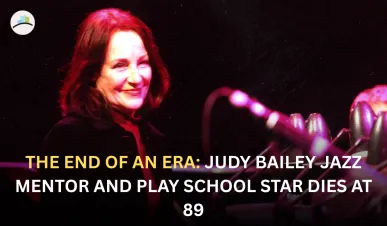
Honestly, this one hurts in a gentle kind of way. Judy Bailey wasn’t just a name from a music hall poster — she was the calm, talented presence a lot of kids grew up with, and the artist many musicians credit for their start. She passed away in Willoughby, Sydney, at 89, with her family by her side, after a career that stretched across six decades of jazz, TV, education, and children’s programming. Born in Auckland and raised in Whangārei, she trained seriously from a young age — even earning a Trinity College London performance diploma at just 16 — then moved to Sydney in 1960 and never really left the stage or the studio after that.
A restlessly inventive improviser and committed educator, Judy Bailey's influence over generations of jazz players is incalculable.https://t.co/JnGPDCpYOf
— Limelight (@LimelightArtsAu) August 10, 2025
More than a jazz icon — a builder of scenes
What a lot of people forget is how Judy helped build the places where musicians could actually grow. She cut her teeth at El Rocco — that legendary Sydney cellar — and played with the big TV orchestras when live bands still powered prime time, including ensembles for Channels 7, 9 and 10, and with Don Burrows on ABC. By 1973, she helped set up the jazz studies program at the Sydney Conservatorium of Music and mentored wave after wave of players, later leading the Sydney Youth Jazz Ensemble and touring Southeast Asia with Musica Viva. Her list of recognitions tells its own story — an OAM in 2004, a Bell Hall of Fame induction in 2014, and the Australia Council’s Don Banks Music Award in 2022 — but former students probably say it better: she taught people to really listen, to hear deeply, and that changes everything about how you play.
A double legacy: Play School and improvisation
You know, it’s rare for one person to live two different kinds of fame. Judy did. While she was composing, arranging, and recording — from early albums like You & The Night & The Music (1964) and My Favourite Things (1965) to later work like Another Journey (2018) — she also became part of everyday family life through ABC children’s programming, starting with Radio Kindergarten and then Play School. That crossover mattered more than people admit: it made jazz feel warm and familiar, not distant or difficult, for generations of Australians. She once framed life as improvisation — the idea that being present and responsive is the point — and you can feel that thread running from her piano touch to her classroom sessions to her children’s music work.
Why this matters now — and what we might miss
It’s easy to say “jazz pioneer” and move on, but the quiet part is the institutional scaffolding Judy helped put in place: conservatorium programs, youth ensembles, mentorship pipelines, and a standard of musicianship that raised the bar across the board. That’s not just history — it’s a living system that keeps paying forward, through players, teachers, and even audiences who learned to love improvisation because she made it welcoming. There’s a risk here too: when artists like Judy go, we find out which parts of that ecosystem were being held together by their daily phone calls, their rehearsal-room pep talks, their gentle insistence on taste and time and trust. The opportunity — if we take it — is to invest in the teaching and youth pathways she championed, keep those ensembles vibrant, and make sure kids still meet jazz early, where curiosity starts.
Also read on Procapitas
The human details that stay with people
The tributes landing now talk about her generosity, her humor, and that unmistakable touch at the piano — how a chord you thought you knew suddenly sounded alive and new when she played it. She kept close to community — from Opera House series work to school programs — and bridged the gap between the concert hall and the classroom with real care. She is survived by her children, Chris and Lisette, who were with her at the end — a small but important detail that rounds out the picture of a life fully held, right to the last moment.