
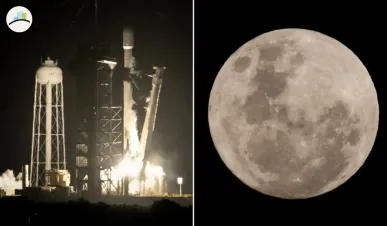
A discarded piece of a SpaceX rocket has reached the end of its uncontrolled journey through space, with scientists expecting it to have slammed into the Moon at approximately 5,400mph, or 8,700km/h, on Wednesday, August 5.
The Falcon 9 upper stage was predicted to strike the lunar surface at around 6.35am UTC, equivalent to 12.05pm in India, close to the Einstein and Bell craters. NASA calculated that the object had a 100% chance of hitting the Moon after gravitational forces and solar activity gradually altered its path.
The predicted impact window has now passed. However, scientists may need several days to confirm the exact location and release images of the newly created crater. The collision was not expected to be clearly visible to the naked eye, making observations from telescopes and lunar spacecraft especially important.
A five-ton piece of a SpaceX rocket is set to crash into the moon overnight, and is likely to create a new crater. The Falcon 9 launched in January 2025, but SpaceX was unable to steer the rocket to Earth. pic.twitter.com/xxySHhK1IJ
— MacdavidGadgets (@mac_david16ayon) August 5, 2026
Did the SpaceX Rocket Hit the Moon?
The spent rocket stage was expected to hit the Moon at approximately 6.35am UTC on August 5.
NASA’s Center for Near Earth Object Studies confirmed before the event that the object had a 100% probability of lunar impact. Independent astronomers had also calculated a collision near the Einstein and Bell craters within a margin of several minutes.
At the time of writing, NASA had not released immediate photographic confirmation of the impact. This does not mean the crash failed to occur. The impact flash was expected to last less than a second and take place against the Moon’s brightly illuminated surface, making it extremely difficult to detect in real time.
Researchers must now compare observations collected before and after the predicted crash. NASA’s Lunar Reconnaissance Orbiter and South Korea’s Korea Pathfinder Lunar Orbiter may eventually photograph the impact site, although lighting, orbital timing and spacecraft position could delay the first clear images.
What Exactly Crashed Into the Moon?
The object was the discarded upper stage of a SpaceX Falcon 9 rocket.
It weighed approximately 3,900 kilograms, or close to four metric tonnes, and had remained in space since launching two commercial lunar landers in January 2025. The rocket carried Firefly Aerospace’s Blue Ghost 1 and Japan-based ispace’s Resilience lunar lander toward the Moon.
Blue Ghost later completed a successful lunar landing, while Resilience was lost during its own landing attempt.
After releasing the spacecraft, the Falcon 9 upper stage did not have enough remaining fuel to return to Earth for a controlled atmospheric re-entry. It was left travelling through a distant and unstable orbit, where the gravitational pull of Earth, the Moon and the Sun gradually changed its trajectory.
The rocket stage was catalogued as 2025-010D and tracked by professional and independent astronomers as its orbit increasingly brought it closer to the Moon.
When and Where Was the Moon Crash Expected?
The most widely accepted prediction placed the impact at:
| Detail | Predicted information |
|---|---|
| Date | August 5, 2026 |
| Time | Approximately 6.35am UTC |
| India time | Approximately 12.05pm IST |
| US Eastern time | Approximately 2.35am EDT |
| Speed | About 8,700km/h or 5,400mph |
| Object | SpaceX Falcon 9 upper stage |
| Weight | Approximately 3,900kg |
| Impact area | Between the Einstein and Bell craters |
| Threat to Earth | None |
The rocket was travelling at approximately 2.4 kilometres per second. Because the Moon has virtually no atmosphere, there was nothing to slow or burn up the incoming stage before it reached the surface.
Small differences remain between scientific estimates of the exact impact point and resulting crater size. This is normal because the object’s rotation, shape, trajectory and the condition of the lunar surface can all affect the final result.
How Big Will the New Moon Crater Be?
NASA estimated that the crash would create a crater approximately 60 feet, or 18 metres, wide and 12 feet, or nearly four metres, deep.
Other scientific modelling has produced larger estimates, with one recent analysis suggesting a crater could measure approximately 40 metres across. The final size will only become clear after an orbiter photographs the impact site.
The collision was expected to instantly destroy or vaporise much of the rocket stage. Lunar rock and dust would then be thrown outward in an expanding cloud known as an ejecta plume.
One study predicted that the main curtain of debris could rise between 15 and 20 kilometres above the surface, while a narrower central spike could reach approximately 75 to 100 kilometres. The debris could also spread more than 180 kilometres across the surrounding lunar area.
Despite the dramatic numbers, the crater will remain tiny compared with the Moon’s enormous natural impact basins.
MORE ARTICLES:
Could the SpaceX Moon Crash Be Seen From Earth?
Not with the naked eye.
The impact flash was expected to be extremely brief and difficult to distinguish from the Moon’s bright surface. Even large professional telescopes faced challenging lighting and weather conditions.
NASA’s Meteoroid Environments Office planned to use ground-based telescopes to try to record the event. Professional observatories and experienced amateur astronomers were also encouraged to monitor the predicted impact region.
The dust plume may have been easier to detect than the initial flash because it could remain above the lunar surface for several minutes. However, any livestream claiming to show a clear close-up of the rocket itself hitting the Moon should be approached carefully.
The rocket stage was far too small and distant for ordinary cameras to record directly. Many online broadcasts used simulations, trajectory maps and telescope views rather than live footage of the object.
Is the Moon Crash Dangerous for Earth?
No. NASA has confirmed that the event poses no danger to Earth or people on its surface.
The rocket was already on a lunar collision course and was not expected to turn back toward Earth. Material thrown up by the crash also lacked the energy needed to escape the Moon and travel toward our planet in any meaningful quantity.
The impact will not alter the Moon’s orbit, affect tides or cause any noticeable change in the lunar surface when viewed without specialised equipment.
NASA noted that a naturally occurring meteoroid carrying similar impact energy strikes the Moon roughly once every six days. The Moon regularly absorbs collisions because it has no thick atmosphere to destroy smaller incoming objects.
What makes this event unusual is not its destructive power. It is the fact that scientists knew the mass, origin, trajectory and approximate impact time of the incoming object in advance.
Why Did SpaceX Not Stop the Rocket?
Once the upper stage had completed its role in the 2025 launch, it reportedly had too little fuel remaining to perform a major course correction or controlled return.
SpaceX normally sends spent Falcon 9 stages back into Earth’s atmosphere, where they burn up, or directs them toward a safe ocean disposal area. That process becomes more difficult during high-energy missions carrying spacecraft far beyond low Earth orbit.
The upper stage involved in this incident had travelled into a distant orbit crossing the region through which the Moon moves. Solar activity and the combined gravitational influence of Earth, the Moon and the Sun gradually pushed it onto a collision path.
SpaceX said the mission followed the applicable rules and disposal requirements. NASA has described lunar impacts as an accepted disposal method in some circumstances, particularly when a controlled and trackable impact is safer than leaving hardware in an unpredictable orbit.
The difference in this case is that the collision was not deliberately planned as a scientific experiment.
Why Is NASA Excited About an Accidental Crash?
Although the event was unplanned, it gives researchers a rare scientific opportunity.
Scientists know the approximate mass, construction and speed of the Falcon 9 stage. If they can measure the resulting flash, dust plume and crater, they can compare the real outcome with computer models of lunar collisions.
That information could help researchers understand:
- How lunar dust moves after a high-speed impact
- How deep material is thrown from beneath the surface
- How large a crater is created by a known impact energy
- How accurately scientists can track objects around the Moon
- What danger future impacts may pose to astronauts and equipment
- How telescope and spacecraft observations can locate impact sites
NASA will use the event partly as a training exercise for tracking objects beyond Earth orbit. This capability will become more important as the number of government and commercial missions travelling around the Moon increases.
NASA’s Search for the First Crash Images
NASA’s ground-based telescopes attempted to observe the collision in real time, but the first useful evidence may come from spacecraft already orbiting the Moon.
The Lunar Reconnaissance Orbiter is expected to look for opportunities to photograph the area before and after the impact. Comparing those images could reveal a dark mark, fresh crater or changed pattern of disturbed lunar material.
South Korea’s ShadowCam instrument, carried by the Korea Pathfinder Lunar Orbiter, may also attempt to gather images.
NASA cautioned that receiving useful pictures could take several days. The orbiters must pass over the correct location while lighting and camera angles are suitable. Scientists must then download and analyse the images before confirming what they show.
The absence of an immediate photograph is therefore expected and should not be mistaken for evidence that the rocket missed the Moon.
Could the Impact Reveal Water on the Moon?
Scientists may examine the debris plume for signs of water or other materials beneath the lunar surface.
When an object strikes the Moon, it can excavate material that has remained buried and protected from direct sunlight. Telescopes may be able to study the light reflected or absorbed by the plume to identify some of its chemical properties.
NASA previously used an intentional impact for this purpose. In 2009, the agency deliberately sent part of its LCROSS mission into a permanently shadowed crater near the lunar south pole. Analysis of the resulting debris helped confirm the presence of water ice.
The Falcon 9 impact occurred in a different region and was not designed specifically to search for water. Researchers may still gain useful information if the plume was bright and large enough to analyse.
Is Space Junk Becoming a Problem Around the Moon?
The crash has renewed concerns about debris travelling between Earth and the Moon, a region known as cislunar space.
Thousands of spacecraft and pieces of debris are tracked around Earth, but objects travelling much farther away can be more difficult to monitor continuously. Their paths can change over time because of complicated gravitational forces and solar radiation.
At present, an isolated rocket impact on an empty section of the Moon creates little immediate danger.
That calculation could change as NASA’s Artemis programme, China’s lunar plans and private companies place more spacecraft, scientific instruments and eventually human habitats on or near the lunar surface.
An uncontrolled impact near an active base could damage equipment directly or send fast-moving dust and rock across a large area. Scientists are studying this crash partly to understand how serious such risks could become.
The incident may strengthen calls for clearer international guidelines covering the tracking and disposal of rocket stages used during lunar missions.
Have Other Spacecraft Crashed Into the Moon?
Yes. Both intentional and accidental lunar crashes have happened before.
Space agencies have deliberately sent spacecraft and rocket stages into the Moon for scientific research or controlled disposal. The Apollo programme left hardware on the lunar surface, while NASA’s LCROSS mission intentionally created an impact in 2009.
Other lunar landing attempts have ended in accidental crashes, including India’s Chandrayaan-2 lander in 2019 and Russia’s Luna-25 mission in 2023. A rocket stage believed to have come from a Chinese lunar mission also struck the Moon in 2022.
The SpaceX event stands out because astronomers were able to track the object well in advance and organise coordinated observations around its predicted arrival.
What Happens Next?
The immediate focus will be on confirming the impact and locating the new crater.
NASA and participating observatories will review telescope data for any flash or dust plume. Lunar orbiters will then attempt to photograph the area between the Einstein and Bell craters.
Researchers will compare the observed crater and debris field with their predictions. Any differences could help improve models used to assess natural meteoroid strikes, deliberate spacecraft impacts and future space-junk hazards.
SpaceX and NASA may also review whether different disposal plans could reduce the chance of unplanned lunar impacts during future high-energy launches.
For the public, the most anticipated development will be the release of the first before-and-after images. Those photographs could provide the clearest evidence of where the discarded rocket ended its 18-month journey.



