
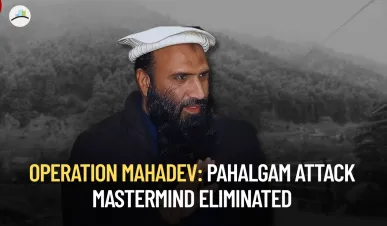
Honestly, this feels like one of those moments where justice finally catches up. On July 28, security forces launched Operation Mahadev deep in the forested areas near Mahadev Peak, just outside Srinagar. After weeks of tracking, they managed to eliminate three heavily armed terrorists responsible for the brutal April 22 Pahalgam attack. Among them was Sulaiman, also known as Hashim Musa — a former special forces commando who had crossed over and joined Lashkar-e-Taiba.
The two others killed were Jibran and Hamza Afghani — both foreign nationals. All three were high-ranking, well-trained, and carried encrypted communication gear and combat weapons. This was not some random encounter. It was a strategic, intelligence-backed operation aimed at dismantling a highly coordinated terror mission.
Why This Operation Really Matters
A Message Beyond the Kill Count
This isn't just about eliminating three men. It's a clear message: if you plan or carry out terror attacks in India, especially against civilians, you will be hunted down — no matter where you hide. The operation sends a strong signal that accountability will follow, and not just inside the courtroom. It's also part of a pattern — one that's showing a more assertive and precise counter-terror policy.
Crippling a Bigger Network
These weren’t just foot soldiers. Sulaiman had serious military experience and was considered the mastermind of the Pahalgam incident. His links to global terror networks make this hit even more important. Disrupting a node like this shakes up operational planning and forces terror outfits to go back to the drawing board.
Building Global Pressure
This mission also strengthens India’s international stance. One of the groups involved, TRF, had recently been declared a global terrorist organization. Operations like this help India build credibility when lobbying globally against state-backed terror.
MORE ARTICLES:
What Most People Are Missing
-
No Major Escalation: This was a high-stakes operation, but it was executed in a way that avoided escalating tensions with neighboring countries. That’s rare — and smart.
-
Technology Edge: The forces reportedly tracked encrypted communications and used drone intel to locate the targets. This hints at an evolving, smarter anti-terror strategy.
-
Domestic Questions Still Unanswered: Despite this success, there’s still one big elephant in the room — how did such a horrific attack happen in the first place? The security lapses in Pahalgam haven’t been fully addressed.
What This Means Going Forward
| Area | Possible Outcome |
|---|---|
| Politics | The government might use this as proof of strong leadership. The opposition will likely still demand accountability for earlier lapses. |
| Security | Forces may get more autonomy to act quickly on intelligence. But it could also trigger new attacks as retaliation. |
| Regional Impact | With no major cross-border flare-up so far, it shows India’s growing confidence in carrying out targeted responses. |
| Economy | Kashmir’s tourism, which was already fragile, might take another short-term hit unless public confidence is restored. |
Also, eliminating a top operative doesn’t mean the network dies immediately. Sometimes, it gets more dangerous before it breaks apart.
A Bit of Historical Perspective
This isn't the first time India has responded this way — think back to earlier targeted strikes or anti-insurgency ops in Kashmir. But there’s a shift now: precision, speed, and political backing seem stronger than before. That’s new. And it might redefine how India handles internal and external threats going forward.
What To Keep an Eye On
-
Will there be proof of Sulaiman’s identity? A public confirmation would close the loop and have symbolic weight.
-
How will neighboring countries react — diplomatically or behind the scenes?
-
Are there more local enablers involved? Investigations into sleeper cells and logistics support are likely underway.
Final Thoughts
So, why does this matter? Because the people who were killed in Pahalgam — tourists, honeymooners, even a pony handler — deserve justice. And because it shows that India’s response to terrorism isn’t just about making statements. It’s becoming surgical, timely, and, most importantly, personal. Operation Mahadev wasn’t just a military move — it was a statement of intent.



