
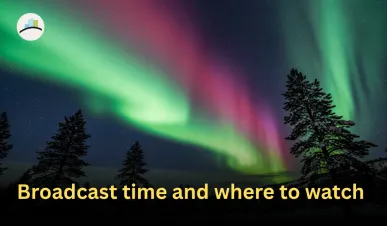
If you’ve ever dreamed of seeing the Northern Lights without flying all the way to Alaska or Scandinavia, this week might give you your chance. A powerful solar storm is on its way, and it could light up the night sky across much of the northern United States.
When & Where to Watch
-
The most favourable viewing window is evening into early morning — approximately from 4 p.m. to 10 p.m. Eastern Time (ET) and then more intensely around 10 p.m. to 1 a.m. ET.
-
Because of time‑zones, that corresponds roughly to 1 p.m.–7 p.m. Pacific Time (PT), 3 p.m.–9 p.m. Mountain Time, and 2 p.m.–8 p.m. Central Time, with peak early‑night into late evening/early morning local for each region.
-
States across the northern U.S. stand the best chance: think Minnesota, Michigan, New York, Washington — and under this storm setup, possibly as far south as northern California and Alabama depending on conditions.
-
Tip: The darker the sky and the farther north you are, the stronger the chance. But even mid‑latitudes could get a show if things line up.
MORE ARTICLES:
Viewing Tips & Broadcast‑Time Notions
-
Find a dark spot, away from city lights, and face toward the northern horizon.
-
Check local weather — clouds can ruin the view.
-
Use your camera or smartphone in night or long‑exposure mode — often the camera picks up more than your eye.
-
Although “broadcast time” isn’t applicable in the sense of a TV show, the key window is the evening and early morning hours as outlined above.
-
If you’re planning to tell others (e.g., via an announcement or live‑feed), aim to begin watching about 30 minutes after sunset local time, and continue into the first few hours after midnight local for the best odds.
Why the Sky Might Glow
The sun recently erupted with several strong solar flares, sending bursts of charged particles hurtling toward Earth. When these particles collide with our planet’s magnetic field, they create the dazzling auroras — streams of green, pink, and purple light rippling across the sky. Normally, these are reserved for far northern regions, but this solar storm is strong enough that people much farther south could get a glimpse.
When & Where to Look
-
Best viewing times: Tonight and the early morning hours, roughly 10 p.m. to 1 a.m. local time.
-
Best locations: The northern U.S. states have the best chance, including parts of Minnesota, Michigan, New York, Washington, and even some areas farther south under ideal conditions.
-
Tips: Find a dark spot away from city lights, face north, and keep your camera ready — sometimes the camera captures more than the naked eye.
A Rare Opportunity
This solar storm is one of the strongest of the year, and the auroras could be visible at latitudes far south of their usual range. Space weather experts warn that while it’s a spectacular show, it can also slightly affect satellite communications and power grids — but for most of us, it’s safe and mesmerizing to watch.
A Moment to Pause and Look Up
Imagine standing under the night sky, the stars sparkling above, and ribbons of light dancing overhead in shades of green and purple. It’s a reminder of just how connected we are to the sun and the universe around us. For anyone in the right place tonight, this isn’t just a forecast — it’s a front-row seat to nature’s own light show.



