
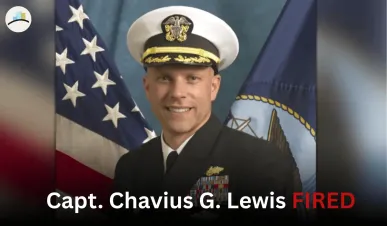
The U.S. Navy has removed the commanding officer of the guided‑missile destroyer USS Mason (DDG 87), firing him in a rare move that drew attention across military circles and news outlets. Rear Adm. Alexis T. Walker relieved Capt. Chavius G. Lewis of duty “due to a loss of confidence in his ability to command”, a phrase the Navy often uses in high‑level leadership changes.
What Happened to the USS Mason Commander?
On Feb. 13, 2026, Capt. Chavius G. Lewis who took command of the Mason in November 2024 was removed by the commander of Carrier Strike Group 10 during a routine training period. The Navy did not publicly disclose specifics beyond the official wording that his leadership was no longer trusted.
FIRED
— Williams Kris (@kris_willi28289) February 13, 2026
Destroyer USS Mason
Navy fires commander of destroyer USS Mason | Stars and Stripes
The Navy fired Capt. Chavius G. Lewis, who had commanded the ship since November 2024, “due to a loss of confidence in Lewis’ ability to command.” https://t.co/za7QDSZuH6
The destroyer’s mission and current schedule remain unaffected, the Navy said. An interim commanding officer, Capt. Kevin Hoffman, has been named while Lewis transitions to a new assignment.
What “Loss of Confidence” Usually Signals
In U.S. naval terminology, “loss of confidence in ability to command” is a formal phrase used when a commander is relieved of duty but the service does not want to air specific details publicly. It can reflect concerns about:
-
Leadership or judgment issues
-
Failure to meet Navy standards
-
Operational mistakes or lapses in safe conduct
The Navy often keeps the precise reasons internal, citing the importance of command accountability and operational security.
Impact on USS Mason and Broader Fleet Operations
Despite the change in leadership, officials emphasize that USS Mason’s mission status hasn’t changed. The Arleigh Burke‑class destroyer is part of U.S. 2nd Fleet forces and was participating in a Composite Training Unit Exercise (COMPTUEX) at the time of the transition.
This kind of mid‑course command reshuffle, while rare, underscores the Navy’s high standards for leadership even during critical training and deployment preparations.
MORE ARTICLES:
Why Leadership Changes Make Headlines
Commanding officers of frontline naval vessels hold immense responsibility, from overseeing weapons systems to crew readiness and safety. When one is relieved suddenly, it can prompt questions about what went wrong even if the Navy withholds specific details. The phrase “loss of confidence” has been used in the past across services, often when leadership expectations weren’t met but underlying issues remain classified or internal.



