
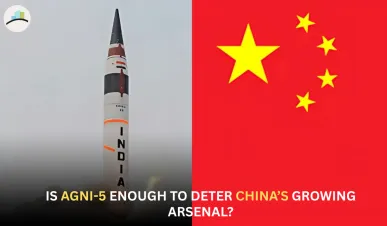
India’s successful test-firing of the Agni-5 intermediate-range ballistic missile (IRBM) is more than a military headline. For defense enthusiasts, policymakers, investors, and ordinary citizens, the real question is: What does this mean for India’s future security, economy, and place in the world?
Many news outlets stop at describing range and capability, but what is missing is a deeper conversation about why this matters now, how it changes India’s deterrence calculus, and the risks and opportunities that follow.
Why Is Agni-5 Important in 2025?
The test comes at a time of heightened geopolitical flux:
-
China’s assertiveness in the South China Sea and along the Line of Actual Control (LAC).
-
Pakistan’s nuclear posture backed by Chinese support.
-
Uncertain alliances, with Russia drifting closer to China and the U.S. pushing India to play a stronger Indo-Pacific role.
Agni-5’s range of over 5,000 km effectively brings the whole of China within India’s deterrence envelope. This shifts India from being a primarily regional power to one with credible long-range strike capability, placing it alongside nuclear states like the U.S., Russia, China, France, and the UK.
Discover the successful test-firing of India's Agni-5 missile, enhancing strategic deterrence with a range of over 5,000 km and advanced navigation systems.
— theviralmail (@theviralmail) August 20, 2025
More details: https://t.co/3F7MXjsZus#DRDO #agni5 pic.twitter.com/DBJ0YqVFGy
Data Comparison: India vs. China vs. Pakistan Missiles
| Country | Missile | Type | Range (km) | Warhead Capacity | Status | Key Strategic Target |
|---|---|---|---|---|---|---|
| India | Agni-5 | IRBM | 5,000–5,500 | ~1.5 tons (nuclear capable) | Operational | All of China, Asia-Pacific |
| China | DF-41 | ICBM | 12,000–15,000 | Multiple warheads (MIRV) | Operational | U.S., Global targets |
| Pakistan | Shaheen-III | MRBM | ~2,750 | Nuclear capable | Limited deployment | Entire India |
Key Takeaway: While China still outpaces India in range and MIRV technology, Agni-5 neutralizes Beijing’s advantage in South and East Asia. For Pakistan, India’s edge is overwhelming.
Economic & Industrial Relevance: Beyond the Battlefield
Agni-5 is not only about defense but also about economic leverage:
-
Boost to Atmanirbhar Bharat (Self-Reliant India)
-
Over 80% of its components are sourced domestically, strengthening India’s indigenous defense ecosystem.
-
Companies in advanced composites, propulsion systems, and guidance technologies stand to benefit.
-
-
Spillovers to Civilian Industries
-
Missile R&D often leads to advances in space exploration, aviation, and materials science. ISRO’s heavy-lift vehicles already benefited from missile research.
-
-
Defense Exports Potential
-
While India won’t export Agni-5 (due to non-proliferation commitments), the credibility of such technology enhances the marketability of Indian defense products to Southeast Asia, Africa, and Latin America.
-
Risks Not Discussed Enough
While the Agni-5 strengthens India’s deterrence, several hidden risks deserve attention:
-
Regional Arms Race: Each Indian test prompts China to accelerate its missile programs. This cycle risks a destabilizing arms build-up.
-
Nuclear Threshold Uncertainty: More powerful delivery systems increase the risk of doctrinal shifts in crisis situations, especially without arms-control agreements in Asia.
-
Economic Trade-Off: Defense R&D is costly. With India targeting $5 trillion GDP by 2027, high defense budgets must be balanced against health, infrastructure, and education spending.
More Articles:
Historical Perspective
Agni-5 mirrors the U.S. Minuteman missile program in the 1960s, which did not just deter the Soviet Union but also cemented America’s defense-industrial complex.
Similarly, India’s test is as much about global signaling as it is about hard power.
It also echoes France’s independent nuclear doctrine during the Cold War — asserting that India, too, will maintain strategic autonomy instead of aligning fully with the U.S. or Russia.
Expert Opinion: Balancing Deterrence and Diplomacy
-
For Policymakers: The test shows India is serious about deterrence, but equally important will be investing in missile defense and cyber resilience to prevent vulnerabilities.
-
For Businesses: Defense-industrial growth will spill into civilian industries, making aerospace and advanced materials key investment themes.
-
For Citizens: The test reassures India’s security against external threats but raises questions about whether defense spending will constrain social investment.
Why This Matters for the Future
Agni-5 is not just another missile test — it is a strategic declaration that India is preparing to secure its long-term future in a volatile Asia.
-
It strengthens deterrence against China.
-
It boosts India’s defense industry and global credibility.
-
But it also risks accelerating an arms race and diverting funds from domestic needs.
The real test for India will be not just building missiles but ensuring they act as stabilizers, not triggers, in an increasingly uncertain world.



