
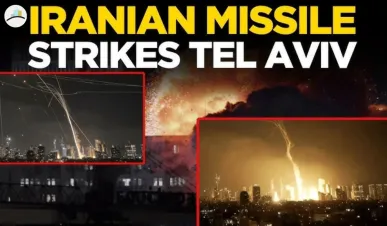
The already volatile situation in the Middle East intensified after Iran launched a retaliatory missile strike toward Israel, reportedly targeting the major oil refinery complex in the northern Israeli city of Haifa. The attack is believed to be a response to recent Israeli strikes on Iranian energy facilities, pushing the long-standing Iran–Israel shadow conflict into a more direct and dangerous phase.
Air raid sirens were heard across parts of northern Israel as missiles were detected approaching the Haifa region, which hosts one of the country’s most important energy and industrial hubs. Israeli air defense systems were quickly activated to intercept the incoming projectiles. While several missiles were reportedly intercepted, videos circulating online appeared to show explosions and fires near industrial areas, raising concerns about potential damage to refinery infrastructure.
What Is a Retaliatory Missile Attack?
A retaliatory missile strike refers to a military response carried out after a country’s territory, assets, or strategic infrastructure have been attacked. Instead of initiating a conflict, the attacking country claims it is responding to an earlier strike in order to deter further aggression or demonstrate military capability.
In this case, Iran’s missile launch is widely seen as a response to Israeli operations that reportedly targeted Iranian fuel depots and energy facilities near Tehran. Retaliatory strikes are particularly dangerous because they often trigger a cycle of escalation—each side responding to the other with increasingly powerful attacks.
Other Articles
-Timothée Chalamet Faces Backlash Over “No One Cares About Ballet and Opera” Comments
-Crufts 2026 Winner: Clumber Spaniel Takes Best in Show at Crufts
How Dangerous Are These Missiles?
Retaliatory missile strikes often involve ballistic or long-range missiles, which are among the most destructive weapons used in modern warfare. These missiles can:
-
Travel hundreds to thousands of kilometers within minutes
-
Carry high-explosive or precision warheads capable of destroying large facilities
-
Cause massive fires and infrastructure damage when they hit industrial zones
When such missiles are aimed at energy infrastructure like oil refineries, the risk increases dramatically. Refineries store huge quantities of crude oil and chemicals, meaning even a single strike can trigger fires, toxic smoke, and large-scale industrial disruption.
Why the Haifa Refinery Matters
The Haifa Bay area is home to Israel’s largest oil refinery and several petrochemical plants that play a crucial role in the country’s fuel production and distribution network. Any disruption in this region can affect:
-
Fuel supply within Israel
-
Regional shipping and energy logistics
-
Industrial production in northern Israel
Even limited damage to refinery infrastructure can take weeks or months to repair, making such facilities highly sensitive strategic targets.
Could This Trigger a Global Oil Crisis?
Energy analysts are increasingly concerned that attacks on oil infrastructure in the Middle East could disrupt global energy markets. The region remains one of the world’s most critical oil supply centers.
If the conflict escalates further, several risks could emerge:
1. Supply disruptions
Missile strikes on refineries, pipelines, or storage depots can reduce production and limit exports.
2. Shipping threats
Escalation could threaten major shipping routes such as the Strait of Hormuz, through which roughly one-fifth of the world’s oil supply passes.
3. Oil price spikes
Even the fear of supply disruption can push global oil prices upward, affecting fuel costs, inflation, and transportation worldwide.
4. Broader regional involvement
If additional countries become involved, the conflict could spread across multiple energy-producing regions in the Middle East.
A Region on Edge
With both Iran and Israel now targeting strategic infrastructure, analysts warn that the conflict could enter a prolonged cycle of retaliation. Attacks on energy facilities not only raise military tensions but also increase the risk of economic shockwaves far beyond the region.
As the situation continues to unfold, global markets, governments, and energy companies are closely watching the developments, aware that any further escalation could have consequences not just for the Middle East—but for the entire world.



