
China at a Crossroads: Navigating Military Expansion, Economic Pressures, and Social Strains
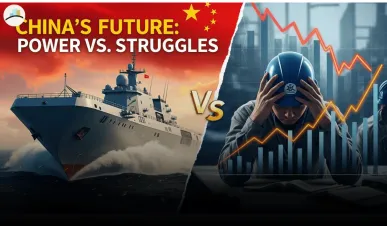
China is currently navigating a complex set of challenges, where ambitious military build-up, economic struggles, and rising social tensions intersect. As China steps up its maritime capabilities, particularly with the launch of its next-generation amphibious assault ship, it faces an economy that’s slowing down and an increasingly disillusioned workforce. These elements, though seemingly separate, are deeply connected in shaping China's future trajectory.
MORE ARTICLES:
Military Build-Up: Projecting Power Beyond Borders
China will never compromise or concede on its core interests such as national sovereignty and territorial integrity, and any force that dares to obstruct China's reunification is doomed to fail, said Chinese foreign ministry spokesperson. pic.twitter.com/Mkx2og27DH
— China Xinhua News (@XHNews) November 14, 2025
In recent months, China has advanced its naval ambitions with the commissioning and sea trials of a next-generation amphibious assault ship. This vessel is set to enhance China’s military projection capabilities, allowing it to deploy both landing craft and aircraft, increasing its flexibility in potential conflict zones like the Taiwan Strait and the South China Sea. With its growing fleet of advanced ships and strategic military investments, China is clearly positioning itself as a regional powerhouse.
However, this military expansion doesn’t come without its challenges. These investments require significant financial resources, skilled labor, and technological innovations, all of which are impacted by the state of China’s economy. While military advancements are a sign of strength, they could be constrained by economic difficulties that limit China’s capacity to sustain long-term military investments.
Economic Pressures: Slowing Growth and Uncertainty
China’s economic landscape is shifting, with signs of weakening growth. Despite its large scale, China is struggling with sluggish investment, faltering exports, and weak consumption. This deceleration is compounded by structural issues like overcapacity, high debt, and inefficiencies in various sectors. These challenges have created an environment where economic growth is not keeping pace with the government's ambitious plans, including its military aspirations.
The slowing economy places further pressure on China’s social stability. As the government pushes for increased defense spending and foreign investment, it risks exacerbating domestic inequalities, especially when many sectors of the economy are facing stagnation. The disparity between China's rising military power and its economic drag is becoming a critical issue.
Social Strains: Rising Discontent Among the Workforce
The economic struggles are having a real impact on everyday life in China. A growing number of educated individuals are finding themselves underemployed or forced into low-wage jobs, despite years of study and professional training. Stories of law graduates from prestigious universities working as delivery drivers or in gig economy roles reflect the widening gap between expectations and reality for many Chinese citizens.
This social strain is particularly apparent among the youth, who face diminishing returns from their education and growing competition for fewer jobs. With high levels of underemployment, many young professionals are being pushed to the margins, questioning the social contract that once promised upward mobility through hard work and education.
The intersection of these challenges — economic stagnation, rising youth unemployment, and increasing reliance on military expansion — represents a dangerous crossroads for China. While its military power grows, its economic and social base is weakening, leading to a complex internal dynamic.
The Risk of Overstretch: How These Challenges Are Connected
The central issue that arises from these interconnected trends is how China will balance its military ambitions with its economic and social challenges. Military expansion requires a robust economy to fund new technologies, ships, and personnel. Yet, if economic difficulties continue to hinder growth, China may struggle to maintain the resources necessary to keep its military ambitions on track.
Moreover, rising social unrest, particularly among the youth, could lead to internal instability. If citizens feel their education and hard work are not rewarded with economic opportunity, the government may face increasing dissent. As China pushes forward with its military projects, it must also address these internal pressures, or risk alienating its workforce and social base.
Looking Ahead: Key Indicators to Watch
Several factors will determine how China’s future unfolds:
-
Military Expansion: How quickly and effectively will China be able to continue its military build-up, particularly its naval capabilities? Will these ships actually be deployed in real-world operations, or will they remain symbols of ambition?
-
Economic Revival: Can China turn its economic fortunes around? Will investment and consumption rise again, or will structural issues continue to drag on growth?
-
Social Stability: How will China address its growing social divides? Will policies shift to prioritize job creation and economic opportunities for the younger generation, or will China continue to focus primarily on external power projection?
-
Government Response: Will China adjust its foreign ambitions to accommodate its domestic challenges, or will it continue to push ahead with military and diplomatic initiatives despite economic and social constraints?
Conclusion: Balancing Act
China stands at a delicate balance between military power, economic health, and social stability. While its naval capabilities and defense strategies are growing, the economic slowdown and social pressures at home could complicate its ambitions. How China navigates this delicate intersection will determine its future — not just as a global power, but as a stable and prosperous society for its citizens.
At this crossroads, China faces a significant choice: continue to invest heavily in military power while managing an increasingly strained economy and restless workforce, or recalibrate its strategy to address the internal challenges before seeking further external expansion. The decisions made today will shape China’s place in the world for decades to come.



