
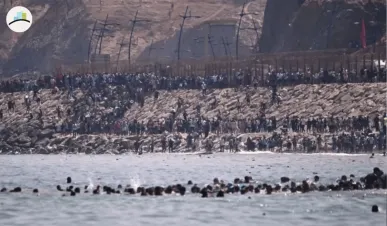
A major migration crisis has unfolded at the Morocco-Spain border after thousands of migrants crossed into Spain’s North African territory of Ceuta, creating chaotic scenes and forcing authorities to strengthen security operations.
The sudden arrivals saw migrants attempt dangerous crossings from Morocco, including swimming around coastal barriers and using flotation devices to reach Spanish territory. Others crossed through land border areas, overwhelming local authorities.
The Spanish government responded by deploying additional police and military personnel to support border control efforts and manage the situation.
What Happened at the Ceuta Border?
The crisis developed when a large number of migrants attempted to enter Ceuta from Morocco in a short period.
Videos circulating online showed groups of people entering the Spanish enclave through coastal routes, with many arriving by swimming or using inflatable tubes.
Authorities reported thousands of arrivals, while emergency services responded to the humanitarian and security challenges created by the sudden movement of people.
At least nine people were reported dead during the crossings, highlighting the dangers involved in attempting to reach Spanish territory through the sea route.
Why Is Ceuta Important in the Morocco-Spain Border Crisis?
Ceuta is a Spanish autonomous city located on the northern coast of Africa.
Spain will deploy its military to restore order at its border with Morocco in Ceuta after thousands of migrants streamed into the tiny Spanish territory, with at least nine dying in the attempt.https://t.co/l6gS2JGuRi
— The Hindu (@the_hindu) July 31, 2026
Although geographically surrounded by Morocco, Ceuta is legally part of Spain and therefore represents one of the European Union’s only land borders with Africa.
Because of its location, Ceuta has become one of the main entry points for migrants hoping to reach Europe.
The territory has repeatedly experienced migration pressure due to its position between Africa and the European Union.
Spain Deploys Military Forces After Border Surge
Following the sudden increase in arrivals, Spain deployed additional forces to help restore control around Ceuta.
The response included:
- Additional police officers
- Military personnel
- Border security teams
- Emergency services
Officials said the deployment was aimed at supporting local authorities and managing the large number of arrivals.
How Did Migrants Cross From Morocco Into Ceuta?
Many migrants attempted to enter Ceuta through maritime routes.
Some reportedly swam around coastal barriers while others used makeshift flotation devices to reach Spanish territory.
The crossings are extremely dangerous because of strong currents, exhaustion risks and overcrowding.
Authorities have repeatedly warned migrants about the dangers of attempting irregular sea crossings.
Why Are Migrants Trying to Reach Ceuta?
Ceuta represents an entry point into European territory.
Many migrants arriving at the border are seeking better economic opportunities, safety or the possibility of applying for protection in Europe.
Migration routes through North Africa have remained active for years due to economic challenges, political instability and hopes of reaching European countries.
Humanitarian Concerns Grow After Deadly Crossings
The crisis has raised concerns about the safety of migrants attempting dangerous journeys.
Emergency workers have assisted people arriving exhausted, injured or requiring medical attention.
Human rights organisations have repeatedly warned that stricter border controls alone cannot address the deeper reasons pushing people toward dangerous migration routes.
Morocco-Spain Relations Under Pressure
Migration has often been a sensitive issue between Morocco and Spain.
The two countries cooperate on border management, but sudden migration surges have previously created diplomatic tensions.
The latest crisis has once again placed attention on the relationship between European border policies and cooperation with neighbouring countries.
Ceuta’s Previous Migration Challenges
This is not the first major migration crisis involving Ceuta.
The territory experienced a similar surge in 2021 when thousands of migrants crossed from Morocco into the enclave during a period of diplomatic tension between Spain and Morocco.
That event became one of the largest irregular migration incidents in Spain’s recent history.
MORE ARTICLES:
Spain Faces Political Debate Over Migration Policy
The latest arrivals have renewed political discussions inside Spain and across Europe.
Debates are focusing on:
- Border security
- Migration controls
- European responsibility sharing
- Humanitarian protections
Different political groups have offered competing views on how governments should respond to migration challenges.
What Happens Next at the Ceuta Border?
Authorities are continuing security operations while assessing the situation.
Spain is expected to coordinate with Moroccan officials as both countries manage the consequences of the sudden migrant movement.
The coming days will determine whether the situation stabilises or whether further pressure develops along the border.
Why This Crisis Matters Beyond Spain
The Ceuta situation reflects a wider European migration challenge.
Countries across the continent continue debating how to balance border security with humanitarian responsibilities.
As migration pressures increase, border regions like Ceuta remain at the centre of one of Europe’s most complex political and humanitarian issues.
Conclusion
The latest Ceuta migrant crisis has highlighted the continuing challenges surrounding the Morocco-Spain border.
Thousands of migrants attempting to enter Spanish territory have triggered a major security response, with Spain deploying additional forces while emergency teams address the humanitarian impact.
The situation shows why Ceuta remains one of Europe’s most sensitive migration hotspots, where geography, politics and humanitarian concerns meet.



