
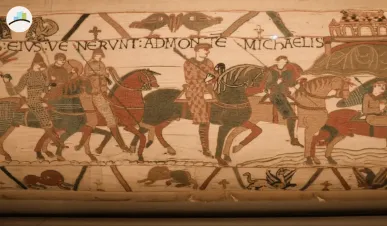
A piece of medieval history has made a remarkable journey back to Britain.
The Bayeux Tapestry, one of the world’s most famous historical artworks, has arrived at the British Museum in London for the first time in almost a millennium.
The extraordinary textile, which tells the dramatic story of the Norman Conquest of England in 1066, was transported from Bayeux, France, under strict security and conservation measures because of its fragile condition.
Its arrival has created global interest among historians, museum visitors and people searching for answers about the story behind one of the most important surviving medieval artworks.
What Is the Bayeux Tapestry?
The Bayeux Tapestry is a nearly 70-metre-long embroidered artwork that illustrates events leading up to and including the Norman invasion of England in 1066.
Although commonly called a tapestry, experts describe it as an embroidered textile rather than a woven tapestry.
The artwork contains dozens of scenes showing:
- William, Duke of Normandy
- Harold, King of England
- The Norman invasion
- Ships crossing the English Channel
- The Battle of Hastings
It provides a visual record of one of the most important moments in British history.
Why Has the Bayeux Tapestry Come to the British Museum?
The Bayeux Tapestry has been loaned to the British Museum as part of a major cultural exchange between Britain and France.
The artwork normally resides in Bayeux, Normandy, but renovations at its usual museum location created an opportunity for this historic UK exhibition.
The loan is considered a significant cultural event because the tapestry has rarely travelled due to concerns about protecting the fragile medieval textile.
When Will the Bayeux Tapestry Be Displayed in London?
The Bayeux Tapestry will be displayed at the British Museum from September 2026 to July 2027.
The exhibition has already generated enormous public interest, with ticket demand becoming one of the strongest ever recorded for a British Museum exhibition.
Visitors will have the rare opportunity to view the complete artwork in the UK rather than travelling to Normandy.
Why Is the Bayeux Tapestry Important?
The Bayeux Tapestry is important because it acts as a historical record of the events that changed England forever.
The year 1066 marked a turning point when William of Normandy defeated Harold II at the Battle of Hastings and became King of England.
The tapestry captures:
- Medieval warfare
- Shipbuilding
- Clothing and armour
- Royal ceremonies
- Daily life in the 11th century
For historians, it is one of the most valuable surviving visual sources from medieval Europe.
The Story Behind the Bayeux Tapestry
The artwork follows the events before the Norman invasion.
It begins with political events involving Edward the Confessor, Harold and William of Normandy.
The story eventually leads to the famous Battle of Hastings, where William’s forces defeated Harold’s army.
The tapestry presents the Norman perspective of events, making it both a historical source and a piece of medieval storytelling.
Who Made the Bayeux Tapestry?
The exact creators of the Bayeux Tapestry remain uncertain.
Many historians believe it was produced in England during the 11th century, possibly by skilled embroiderers connected to religious communities.
It is often associated with Bishop Odo of Bayeux, William the Conqueror’s half-brother, who may have commissioned the artwork.
How Was the Bayeux Tapestry Transported?
Moving such an ancient artwork required extraordinary planning.
Experts created a specially designed protective system involving:
- Climate-controlled storage
- Shock protection
- Careful monitoring
- Specialist conservation teams
The journey was kept highly secure because even small environmental changes could potentially damage the historic fabric.
MORE ARTICLES:
Hidden Mysteries of the Bayeux Tapestry
Despite centuries of study, many questions remain unanswered.
Historians continue debating:
- Who exactly created it
- Why it was made
- Whether missing sections once existed
- How accurately it represents historical events
One of the biggest mysteries involves the depiction of King Harold’s death during the Battle of Hastings.
Why Are People Excited About the British Museum Exhibition?
For many visitors, this is a once-in-a-generation opportunity.
The Bayeux Tapestry has remained closely connected with France for centuries, and seeing it displayed in Britain carries special historical significance.
The exhibition allows audiences to experience a medieval artwork that directly represents a defining moment in British history.
Bayeux Tapestry Legacy
Nearly 1,000 years after it was created, the Bayeux Tapestry remains one of humanity’s greatest historical documents.
It has survived wars, political changes and centuries of preservation challenges.
Its journey to London represents not only an exhibition but also a rare connection between two countries whose histories have been deeply intertwined.



