
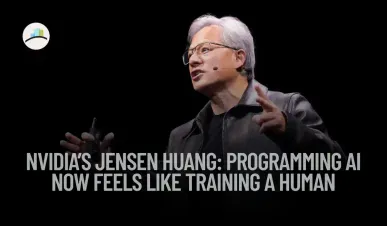
At London Tech Week 2025, Nvidia CEO Jensen Huang introduced a powerful idea that reflects the evolution of artificial intelligence: anyone can now program a computer by simply talking to it. Speaking on stage with UK Prime Minister Keir Starmer, Huang called AI "the great equalizer" because it turns natural human language into the latest form of programming.
The Shift in Programming
According to Huang, the era when only skilled coders could build and control software is over. AI tools now allow anyone, regardless of technical background, to generate code, design visuals, or write creative content simply by giving clear instructions using everyday speech.
Huang emphasized that this shift is revolutionary for both the workforce and the future of computing. He explained that, in the past, one needed to learn programming languages like C++ or Python. But now, AI platforms interpret plain English. In his words, there is a new programming language and that language is human.
Also Read:
Rise of Conversational AI
Conversational AI gained significant momentum with the launch of OpenAI’s ChatGPT in 2022. By early 2025, the tool had 400 million weekly active users. Other AI platforms such as Google Gemini and Microsoft Copilot are also seeing strong growth as users turn to natural conversation to perform a wide range of tasks.
Demonstration at London Tech Week
During the keynote, Huang demonstrated the ease of working with AI by describing a prompt: asking the AI to write a poem summarizing the event. The AI responds and can be asked to improve its answer, just like giving feedback to a person. This, he explained, is how we now train AI — not with code, but with guidance, intention, and conversation.
Impact on Workforce and Businesses
This growing accessibility is creating new possibilities for professionals and individuals across industries. Nvidia, known for its cutting-edge AI chips and processors, is actively supporting this transformation. Huang believes that nearly anyone can now interact with computers meaningfully, not just engineers or developers.
Companies like Shopify, Duolingo, and Fiverr are encouraging employees to use AI tools to streamline workflows. OpenAI recently reported three million paying business users for ChatGPT, indicating how deeply AI has penetrated corporate environments.
Addressing Job Concerns
Huang addressed concerns about AI replacing jobs by shifting the narrative toward augmentation rather than automation. He highlighted that AI should be seen as a partner or assistant that can make human workers more productive and valuable. He urged people to engage with these tools to stay ahead in a rapidly changing world.
Children as Early Adopters
He also pointed to children as early adopters, engaging naturally with AI tools to explore creativity, learn new skills, and express themselves. According to Huang, this is a sign that AI-powered interaction is becoming a basic part of modern life, much like smartphones or internet access.
Nvidia’s Vision and Investments
Huang’s comments align with Nvidia’s broader vision: to enable global digital transformation by making computing more intuitive, accessible, and powerful. He has repeatedly praised the UK for being in what he calls a Goldilocks policy moment — a regulatory environment that supports innovation without overregulation. He has confirmed plans for Nvidia to expand investments in the UK.
Conclusion
London Tech Week continues to serve as a major platform for discussions on digital leadership, future technologies, and the economic impact of AI. Nvidia’s presence at the event signals how integral AI is becoming to both corporate and governmental strategies.
The idea that human conversation can now program machines is reshaping our understanding of work, education, and technology. For Huang and Nvidia, the message is simple: AI is not the future — it is the present, and it is meant for everyone.



