
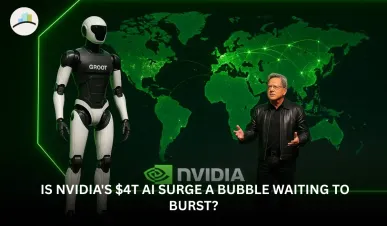
Nvidia’s $4 Trillion Surge: The Hidden Risks Behind the AI Euphoria
Nvidia's historic climb past a $4 trillion market cap is nothing short of breathtaking. Just 18 months ago, the company was valued under $1 trillion. Today, it stands as the second-most valuable public firm on Earth, only behind Microsoft. But behind the soaring stock price and chip-fueled optimism lies a deeper question: Is this the future of tech, or the beginning of a dangerous overconcentration in AI hype?
💰 #Nvidia on Wednesday became the first publicly traded company to hit a $4 trillion valuation.
— FRANCE 24 English (@France24_en) July 10, 2025
🤖 The chip designer has ridden an investor frenzy fuelled by the boom in #AI over the past two years to reach record-breaking success. pic.twitter.com/AbYXg9I3JV
Why Did This Happen?
At its core, Nvidia's meteoric rise is powered by AI—and more importantly, by the insatiable demand for its high-performance GPUs, the computational backbone of everything from ChatGPT to Tesla’s self-driving systems. Major cloud providers, startups, and national governments are racing to hoard Nvidia chips, treating them like 21st-century oil.
But what’s fueling this demand even more is FOMO—a fear of missing out among institutional investors, retail traders, and tech firms alike. AI is now seen not just as a competitive edge, but as an existential necessity. This urgency is driving unrelenting capital into Nvidia and its ecosystem.
What's Not Being Discussed Enough?
Most coverage celebrates Nvidia’s numbers. But few are asking: Is this healthy for the global tech economy?
-
Market concentration: Nvidia now dominates 90% of the AI chip market. This kind of centralization invites geopolitical, supply chain, and innovation risks.
-
Overreliance on a single narrative: Much of Nvidia’s valuation assumes that generative AI will keep growing exponentially. But productivity gains from current AI models remain uneven—and monetization still lags behind usage.
-
Hardware bottlenecks: Ironically, Nvidia’s own success may be its limitation. Scarcity of H100 and Blackwell chips is already slowing down deployment at scale.
More Articles:
Historical Parallels: A Modern Dot-Com Echo?
Nvidia’s current trajectory mirrors Cisco in the late 1990s. In 2000, Cisco briefly became the world’s most valuable company on the back of internet infrastructure hype—before its stock collapsed 80% when expectations proved unsustainable. Nvidia is not Cisco, but the psychology of markets-over-optimism, speculative flows, and winner-takes-all thinking—rhyme closely.
The Geopolitical Undercurrent
Nvidia’s rise also sharpens the U.S.-China chip war. Washington has already restricted advanced chip exports to China, and Nvidia is crafting “downgraded” chips for that market. But China is aggressively investing in domestic alternatives, and a technological bifurcation is unfolding. Any U.S. shift in export policy, or Chinese breakthrough in AI chipmaking, could drastically reshape Nvidia’s future.
Why This Is Important
Nvidia’s growth is reshaping global tech and capital markets. But it’s also concentrating risk, distorting investor behavior, and potentially inflating valuations well beyond fundamentals. If the AI tide turns—due to regulation, chip shortages, or disillusionment—Nvidia may not just correct; it could trigger broader tech market tremors.



